|


| Quantity: | |
|---|---|
|
PDF Export |
|
JSIE5100GXFPM40/Q6
JSIE
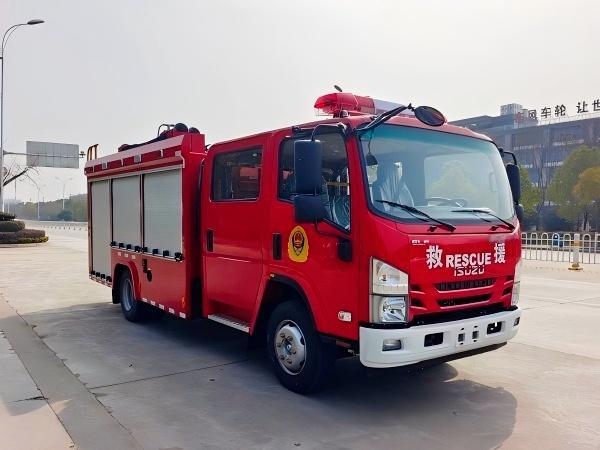
The JSIE 4×2 Water-Foam Fire Truck, model JSIE5100GXFPM40/Q6, is designed for firefighting operations where both water and foam-based suppression may be required. Its tank system provides a listed capacity of 2.95m³ for water and 0.8m³ for Type B foam solution, giving the vehicle a combined nominal tank capacity of 3.75m³.
With a 3+3 crew cab and overall dimensions of 7,025 × 2,300 × 3,050mm, this vehicle is intended for industrial fire brigades, petrochemical facilities, oil storage sites, ports, and other locations where flammable-liquid fire risks need to be considered.
Unlike a conventional water tanker fire truck, a water-foam vehicle combines two firefighting media in one platform. Its effectiveness depends not only on tank capacity, but also on the compatibility of the foam agent, proportioning equipment, fire pump, and discharge monitor.
The vehicle's tank system is divided into two sections:
Water tank: 2.95m³
Type B foam solution tank: 0.8m³
Combined nominal capacity: 3.75m³
Water provides the primary medium for cooling and suppressing suitable fires, while compatible firefighting foam can be used to control certain flammable-liquid fires by forming a blanket over the burning liquid surface.
The separate tank arrangement allows the vehicle to carry both media and select the appropriate firefighting mode according to the incident and the installed system.
One important specification must be clarified before ordering: whether the listed 0.8m³ foam tank stores concentrated foam agent or premixed foam solution. This distinction affects the required proportioning system, actual foam production, and operational duration.
The tank material, internal anti-corrosion treatment, compartment construction, and anti-surge baffles should also be confirmed according to the final configuration.
For a foam fire truck, the tank alone does not determine firefighting performance. The foam proportioner, fire pump, pipeline, and monitor must operate as a coordinated system.
JSIE's product description identifies a fire pump and fire monitor as the main specialized equipment. For a complete procurement specification, buyers should request the following details:
Fire Pump
Confirm the pump model, rated flow, working pressure, maximum suction depth, and water diversion time. These specifications determine the vehicle's water delivery capability.
Foam Proportioning System
Confirm the proportioner model, adjustable mixing ratio, operating flow range, and compatibility with the selected foam concentrate. The correct foam concentration is essential for producing an effective foam blanket.
Water and Foam Monitor
The monitor should be evaluated for rated flow, operating pressure, discharge range, rotation angle, and compatibility with both water and foam discharge.
The product listing currently mentions water and foam discharge ranges exceeding 60m and 55m respectively. These figures should be verified against the actual pump and monitor models before being used as guaranteed performance specifications.
Petrochemical Plants and Oil Storage Facilities
Facilities handling petroleum products may face flammable-liquid fire hazards. A compatible foam system can help cover exposed fuel surfaces and reduce the release of flammable vapors, while water supports cooling and other firefighting operations.
Industrial Warehouses and Manufacturing Facilities
Warehouses and industrial sites may contain different combustible materials and operational hazards. A water-foam fire truck provides two firefighting media, allowing the response team to select an appropriate method according to the material involved and the approved fire protection plan.
Ports and Logistics Terminals
Ports and logistics facilities handle fuels, industrial liquids, vehicles, and packaged goods. A dedicated water-foam fire truck can form part of the site's emergency response fleet, particularly where flammable-liquid storage and handling are involved.
Industrial Parks and Institutional Fire Brigades
For facilities maintaining their own fire response teams, a 4×2 water-foam truck offers a combined water and foam storage platform without requiring separate vehicles for each medium.
Foam type and application method must always be matched to the fuel, incident conditions, and applicable firefighting standards.
The published technical specification identifies the chassis as QL1110ANKAY, manufactured by Qingling Motors Co., Ltd. The vehicle uses a 4×2 configuration and has a listed overall length of 7,025mm, width of 2,300mm, and height of 3,050mm.
Its 3+3 cabin arrangement accommodates up to six occupants, providing space for the driver and firefighting personnel.
The vehicle also lists ABS and an integrated side protection structure. Its rear protection device is made from Q235A steel, with a 100 × 100mm cross-section.
These specifications should be evaluated alongside the tank's filled weight, axle loads, equipment weight, and local road regulations when selecting the final vehicle configuration.
Specification |
Details |
|---|---|
Product Model |
JSIE5100GXFPM40/Q6 |
Vehicle Type |
Water-Foam Fire Truck |
Listed Chassis Model |
QL1110ANKAY |
Chassis Manufacturer |
Qingling Motors Co., Ltd. |
Drive Type |
4×2 |
Water Tank Capacity |
2.95m³ |
Foam Tank Capacity |
0.8m³ |
Total Tank Capacity |
3.75m³ |
Water Tank Dimensions |
1,880 × 1,310 × 1,250mm |
Overall Dimensions |
7,025 × 2,300 × 3,050mm |
Gross Vehicle Weight |
10,200kg |
Curb Weight |
6,000kg |
Rated Load Capacity |
3,750kg |
Maximum Speed |
100km/h |
Crew Capacity |
3+3 Persons |
Approach / Departure Angle |
17° / 12° |
ABS |
Equipped |
Main Firefighting Equipment |
Fire Pump and Fire Monitor |
The published weight figures require confirmation against the final vehicle approval documents. Engine model, rated power, fire pump model, monitor performance, foam proportioning ratio, and tank material should be confirmed before order placement.
For industrial and petrochemical buyers, the following information should be included in the technical quotation:
Water tank and foam tank material, thickness, and internal structure.
Whether the 0.8m³ tank stores foam concentrate or premixed foam solution.
Fire pump model, rated flow, and operating pressure.
Foam proportioner model and adjustable mixing ratio.
Fire monitor model, water range, and foam range.
PTO arrangement and pump operation method.
Fire hoses, suction pipes, foam nozzles, and equipment compartment layout.
Static grounding, emergency shutoff, warning systems, and other required safety equipment.
Chassis brand, engine configuration, emission certification, and destination-market approval.
These details help ensure that the vehicle is configured for the actual fire hazards and operational requirements of the purchasing facility.
Looking for a water-foam fire truck for an industrial facility, petroleum storage site, or emergency response fleet?
Contact JSIE with your required water and foam tank capacities, foam agent type, pump performance requirements, and destination country. Our team can review the vehicle configuration and prepare a quotation based on your firefighting application.