Telephone/WhatsApp: +86-13950097655 E-mail: eric@justsuntrucks.com
Please Choose Your Language

- All
- Product Name
- Product Keyword
- Product Model
- Product Summary
- Product Description
- Multi Field Search
Views: 0 Author: Site Editor Publish Time: 2026-09-27 Origin: Site
Fleet operators handling high-volume earthmoving or mining projects frequently hit a performance wall. Standard 6×4 configurations eventually reach their payload limits during intensive operations. Pushing these smaller setups often results in increased cycle times and excessive strain on equipment. Upgrading to a four-axle setup offers a proven structural solution to heavy payload bottlenecks. However, this shift requires a careful evaluation of site access, axle compliance, and maintenance workflows.
Our objective here is to provide a purely technical and operational breakdown of this heavy-duty architecture. We will analyze real-world capacity, axle dynamics, and exact application matching. You will learn how to align equipment capabilities directly with site demands. By understanding these mechanical nuances, fleet managers can make smarter procurement decisions and avoid mismatched assets. This guide focuses entirely on maximizing your operational efficiency and matching the right machine to your specific project environment.
Payload Scaling: The 8×4 configuration increases legal and operational payload capacity by distributing weight across four axles, ideal for high-density materials.
Axle Mechanics: Dual front-steering axles combined with dual rear-drive axles offer superior load distribution, though they require wider turning radii than 6×4 models.
Application Specificity: Highly efficient for highway construction and controlled mining environments, but may face maneuverability constraints in ultra-confined off-road sites.
Model Nuances: Procurement should weigh classic Sinotruk HOWO models against specialized variants (e.g., TX or NX series) based on specific operational severities.
Fleet managers must define the exact tipping point where a traditional 6×4 chassis becomes an operational liability. Continuous maximum-load hauling places immense stress on standard three-axle designs. This stress inevitably causes premature suspension wear, chassis fatigue, and frequent component failure. You cross this threshold when your daily material targets consistently exceed the safe structural limits of a 6×4 setup.
Moving to an 8×4 configuration changes your operational math. The extra axle fundamentally shifts how you evaluate fuel consumption versus total material moved per shift. While a four-axle truck burns more fuel per hour, it moves significantly more volume per trip. This efficiency reduces the total number of required cycles. Ultimately, operators achieve a higher yield of earth moved per gallon of fuel consumed. You maximize operational output while minimizing route congestion.
Navigating regional bridge laws and axle-weight limits forms a critical part of heavy transport planning. Public highway construction routes strictly enforce these legalities. Authorities measure both Gross Vehicle Weight (GVW) and individual axle loads. A standard three-axle truck hauling dense aggregates often violates these axle limits long before the dump box actually fills up.
This is where the 8×4 dump truck design proves invaluable. By adding a second steering axle, the vehicle spreads the GVW across a larger footprint. This load distribution effectively mitigates overweight fines on public roads. It allows fleets to maximize their legal payload without risking regulatory penalties. You remain compliant while maintaining peak hauling efficiency.
You must differentiate between the manufacturer’s Gross Vehicle Weight Rating (GVWR) and your safe, real-world payload capacity. The GVWR represents the absolute structural maximum under ideal conditions. However, sustained heavy-duty conditions dictate a more conservative operational capacity. Factors like road gradients, material density, and tire ratings all lower your functional payload limit.
High-torque engines play a massive role in actual hauling capabilities. A standard heavy duty tipper truck usually features powerplants ranging from 371HP to well over 430HP. These engines generate the low-end grunt necessary to haul high-density materials like wet gravel, iron ore, or overburden. The combination of high horsepower and four axles ensures the vehicle can climb steep haul roads without bogging down under maximum load.
Selecting the correct dump body directly impacts your daily efficiency and equipment longevity. Buyers generally choose between two primary designs based on their specific material types.
Square Dump Body: This design is ideal for rough mining applications. It maximizes internal volume and prioritizes abrasive material resistance. The flat bottom and thick steel walls withstand severe impacts from large boulders dropped by excavators.
U-Shape Dump Body: This profile is much better for standard construction dump truck tasks. The curved design prevents wet or sticky material from adhering in the corners. It also naturally lowers the vehicle's center of gravity, improving stability during transit.
Hydraulic cylinder evaluation is equally critical. Front-lifting cylinders provide better leverage and superior stability during the tipping cycle. Middle-lifting systems save space but often struggle with off-center loads on uneven ground. You must match the lifting mechanism to your primary dumping environment.
Dump Body Profile Comparison
Feature | Square Dump Body | U-Shape Dump Body |
|---|---|---|
Primary Application | Hard rock mining, heavy demolition | Sand, gravel, highway earthmoving |
Material Adherence | Prone to sticky material build-up in corners | Excellent clean-out; prevents bridging |
Center of Gravity | Higher, requiring highly level dumping ground | Lower, offering better operational stability |
Impact Resistance | Superior against large, heavy boulder drops | Moderate; designed for processed aggregates |
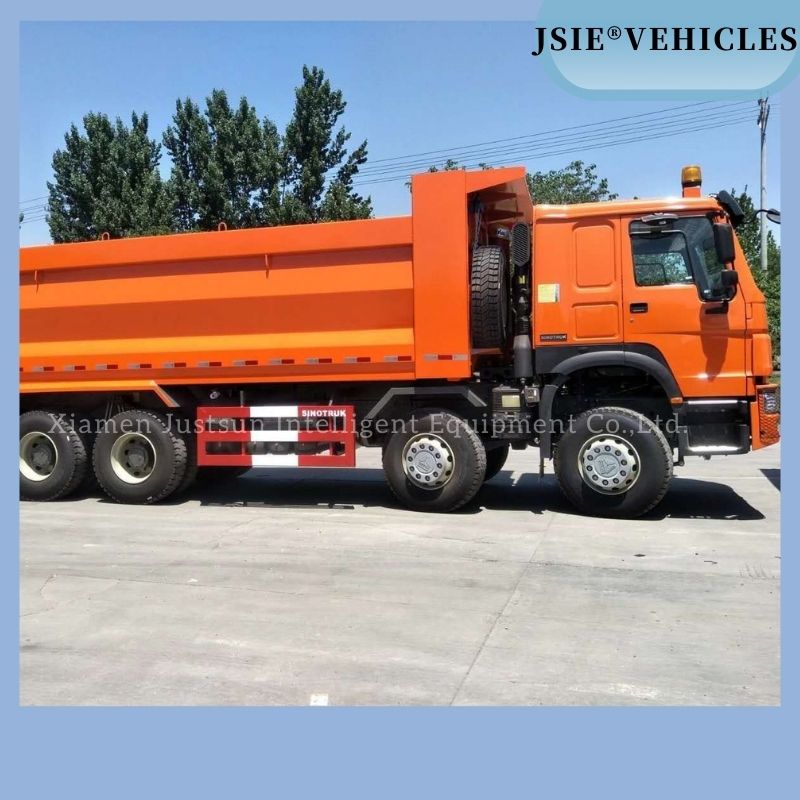
The defining feature of a four-axle setup is its dual front-axle steering system. This mechanical linkage connects the first and second axles, ensuring they turn in unison. The system relies on precise Ackerman steering geometry to guide the heavy front end through curves. This dual setup shares the massive forward engine and payload weight, preventing front suspension collapse.
However, this setup introduces specific maintenance realities. The second steering axle often experiences increased tire scrub. During tight, fully-loaded maneuvers, the turning arcs of the first and second axles differ slightly. This discrepancy causes the tires on the second axle to drag laterally across the surface. Fleet operators must monitor this closely and rotate tires frequently to ensure even wear.
The tandem rear drive axles are engineered strictly for severe traction environments. A hallmark of a genuine Sinotruk HOWO dump truck is its standard hub-reduction driving axles. Instead of placing all the torque multiplication stress on the central differential, hub-reduction systems use planetary gears inside the wheel hubs. This design significantly reduces the torsional load on the half-shafts, preventing snapping under heavy acceleration.
Traction management is another vital component. These trucks utilize both wheel differential locks and axle differential locks. When traversing muddy or low-traction gradients, drivers engage these locks to force all four rear wheels to spin simultaneously. This mechanical override is essential for extracting a fully loaded rig out of deep mud or loose gravel pits.
Heavy-duty leaf springs and reinforced shock absorbers form the backbone of these vehicles. The suspension must be rigid enough to support 30 to 40 tons of dynamic payload without bottoming out. Multi-leaf parabolic springs provide this necessary structural integrity.
Yet, this immense strength carries inherent risks. Stiffer suspensions drastically reduce driver comfort when the truck operates unladen. An empty 8×4 bounding over poor roads transfers severe shockwaves directly into the cabin and chassis. Continuous unladen operation at high speeds on rough terrain can actually increase chassis stress and accelerate structural metal fatigue.
Large-scale highway projects require continuous, high-volume material transport. Success in this sector depends on moving massive amounts of aggregate over semi-paved or fully paved surfaces. In this environment, the four-axle setup is highly efficient.
The operational match here is exceptionally high. The 8×4 Dump Truck thrives on highway infrastructure jobs due to payload maximization. Road gradients are generally predictable, and traction is rarely a limiting factor. The long wheelbase provides excellent high-speed stability, making it the perfect tool for feeding asphalt plants or hauling base layers.
Mining operations demand extreme durability, maximum impact resistance, and strong off-road gradeability. Vehicles must endure continuous abuse from massive excavators and highly abrasive materials.
The match in open-pit mining is strictly conditional. A standard 8×4 works exceptionally well on wide, well-maintained haul roads within the pit. However, operators must specify specialized mining bodies. Thickened square boxes and heavy-duty chassis reinforcements are strictly required. Standard bodies will quickly deform under the impact of uncrushed rock.
Urban sites prioritize maneuverability and tight turning radii. Vehicles must navigate narrow city streets, sharp corners, and confined loading zones. High traffic further complicates these transport cycles.
For these applications, the operational match is low to moderate. The extended wheelbase of a four-axle chassis naturally creates a much wider turning radius. This length makes it notably less efficient than standard 6×4 models in restricted zones. Drivers often require multiple reversing maneuvers to position the vehicle, which slows down the entire excavation process.
Adopting larger vehicles requires an immediate adjustment to your maintenance scheduling. Fleet managers must budget time and resources for increased tire replacement, as you are managing 12 tires instead of 10. The accelerated wear on the dual steering axles means your tire replacement cycles will shorten.
Servicing complexities also increase. The tandem steering linkage requires rigorous and frequent greasing. If the mechanical connections between the first and second axles lose synchronization, the vehicle will suffer severe handling issues. Mechanics must regularly inspect tie rods, drag links, and steering boxes to maintain precise alignment.
Procurement teams face multiple choices within the manufacturer's lineup. Understanding the nuances of each series guarantees the best operational fit.
Classic HOWO: Known for its proven reliability and simpler mechanical layout. It features minimal complex electronics, making it incredibly resilient in remote areas. It also offers the easiest access to aftermarket parts and straightforward mechanical repairs.
HOWO TX Series: This variant targets modern logistical efficiency. It features upgraded cabins for improved driver ergonomics. The TX series utilizes better fuel efficiency mapping and a lighter tare weight, making it highly suitable for strict highway weight compliance.
HOWO NX Series: Serving as a premium option, the NX series blends heavy-duty capability with advanced driver assistance and superior interior comforts. It is designed for operations where driver retention and long-haul fatigue reduction are top priorities.
Before executing a fleet upgrade, procurement teams should follow a strict evaluation checklist.
Terrain Assessment: Map the specific gradients, road surfaces, and turning limitations of your primary sites.
Material Density Calculation: Ensure your average material weight allows you to utilize the extra payload capacity without exceeding axle limits.
Maintenance Capabilities: Verify your current workshop can handle multi-axle steering alignments and larger tire volumes.
Driver Training Requirements: Plan for specific training sessions to help drivers manage the wider turning radii and tandem steering behaviors.
Component Matching: Select the right combination of engine horsepower, gear ratios, and dump body profile for your core application.
The heavy-duty four-axle configuration is not a universal upgrade for every fleet. It remains a highly specific tool engineered for scaling payload where terrain and turning radii permit. When deployed in the right environment, such as highway construction or maintained mining roads, it dramatically reduces cycle times and boosts daily output. However, deploying it in confined urban spaces can negate these benefits entirely.
We advise procurement teams to conduct a thorough, site-specific route analysis before committing to this architecture. Request loaded demonstration runs to observe how the extended wheelbase navigates your toughest corners. Finally, consult a technical sales engineer to ensure exact chassis-to-body matching. Proper planning ensures your heavy equipment investment translates directly into operational efficiency.
A: The structural maximum of the chassis can often handle 35 to 40 tons safely in off-road conditions. However, legal road limits usually restrict the real-world payload to around 25 to 30 tons. This capacity strictly depends on regional bridge laws, axle-weight regulations, and the tare weight of the specific dump body installed.
A: A four-axle truck has a notably larger turning radius than a three-axle model. The extended wheelbase and the fixed geometry of the dual front-steering axles require a wider arc to corner safely. This makes 6×4 models superior for tight urban demolition sites, while the larger chassis is better suited for wide-open highways.
A: The square body is significantly better for mining. Its flat, reinforced steel bottom offers superior structural rigidity against heavy rock impacts from excavators. The U-Shape is better suited for standard construction aggregates, as its curved corners provide excellent clean-dumping efficiency and prevent wet sand from sticking.
A: Many core drivetrain components, such as engines, axles, and suspension hardparts, share similarities and may be interchangeable. However, cabin components, electronic sensors, and fuel mapping systems differ significantly. Maintenance teams should always verify exact part numbers when servicing the newer TX or NX series.