Telephone/WhatsApp: +86-13950097655 E-mail: eric@justsuntrucks.com
Please Choose Your Language

- All
- Product Name
- Product Keyword
- Product Model
- Product Summary
- Product Description
- Multi Field Search
Views: 0 Author: Site Editor Publish Time: 2026-07-02 Origin: Site
Selecting the right specification for your hauling equipment is a high-stakes capital decision. Miscalculations directly impact project margins, site safety, and legal compliance. You cannot afford to guess when outfitting a commercial fleet. Buyers often focus strictly on sheer volume when evaluating options. They unfortunately overlook the critical intersection of material density, tare weight, and axle configurations. This narrow focus creates severe operational bottlenecks and financial liabilities.
This guide provides a definitive framework to accurately evaluate payload limits. You will learn how to select optimal body sizes based on precise material weights. We also show you how to match equipment directly to your specific site realities. By following these steps, you can maximize daily productivity, ensure structural longevity, and stay securely within strict highway regulations.
Evaluating commercial hauling equipment requires an analytical approach to capacity. Mismatched specifications introduce severe financial risks. If you buy a truck with too little capacity, underutilization wastes fuel and labor hours. Your drivers will make unnecessary trips, eroding project margins. Conversely, overloading a dump truck creates major liabilities. You risk hefty Department of Transportation (DOT) fines for exceeding weight limits. Overloading also causes catastrophic component failure, prematurely destroying suspensions, brakes, and drivetrains.
Understanding capacity requires mastering specific weight ratings defined by manufacturers and regulators. You must differentiate between physical space and legal weight limits.
To calculate actual hauling capability, use a simple formula: Payload Capacity = GVWR - Tare Weight. If a truck features a 60,000 lb GVWR and a 25,000 lb tare weight, the legal payload is strictly 35,000 lbs. You cannot exceed this number, regardless of how much empty space remains in the bed.
Material types drastically change the payload equation. You cannot treat a cubic yard of dry topsoil the same as a cubic yard of wet gravel. High-density materials max out the truck's weight capacity long before filling the physical volume. Moisture content further complicates this. Heavy rain can add hundreds of pounds to a load of dirt. Evaluating density prevents you from spec'ing an overly large body for heavy materials.
| Material Type | Average Density (lbs / cubic yard) | Handling Characteristics |
|---|---|---|
| Dry Topsoil | 2,000 - 2,200 | Flows easily, low abrasion. |
| Wet Sand | 3,000 - 3,300 | Highly dense, sticks to corners. |
| Crushed Gravel | 2,500 - 2,800 | Moderate density, highly abrasive. |
| Demolition Debris | 1,400 - 1,800 | Low density, high impact risk. |
| Asphalt (Solid) | 3,900 - 4,000 | Extreme density, requires thermal bodies. |
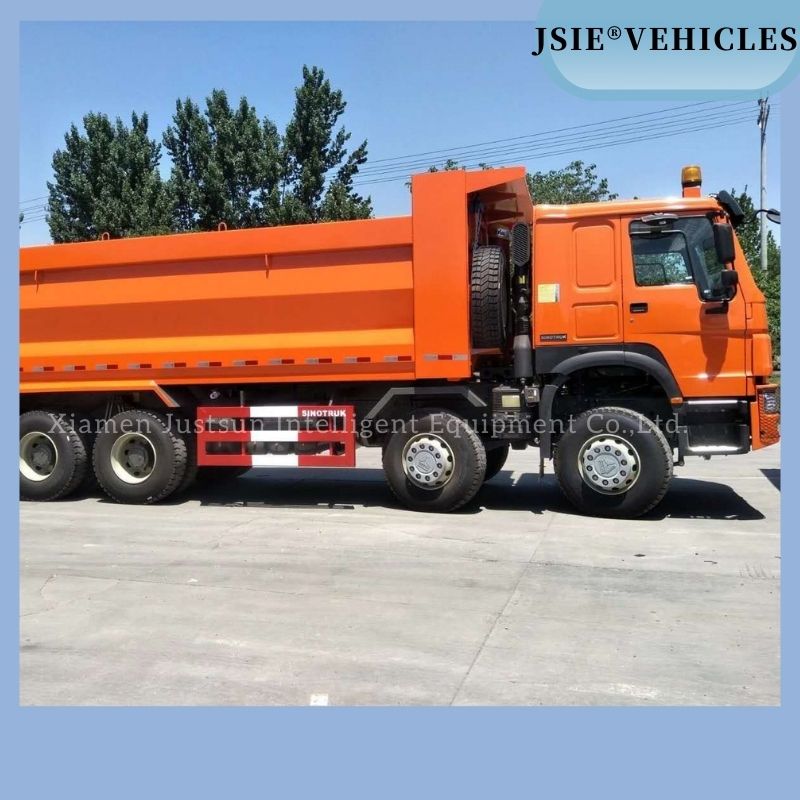
Selecting the right solution category means matching the drivetrain and axle layout to your payload needs. Regulatory frameworks, specifically federal and local bridge laws, dictate maximum allowable weights based on axle spacing. The right configuration balances highway compliance with maneuverability.
The standard tri-axle setup features one steer axle and two driven rear axles. A 6X4 dump truck remains the backbone of many regional fleets. These models offer excellent agility and straightforward maintenance.
When operations demand maximum efficiency per trip, fleets move to four-axle setups. An 8X4 dump truck typically utilizes twin steer axles paired with tandem drive axles. This engineering design fundamentally changes the vehicle's footprint.
Selecting a dump body requires balancing durability with payload optimization. Your primary evaluation criteria should focus on protecting the chassis without unnecessarily cannibalizing payload capacity. Every pound of steel you add to the bed is a pound of revenue-generating material you cannot haul.
The material composition of the bed dictates both tare weight and longevity. You must align the material with your primary hauling tasks.
Specifying bed dimensions requires careful calculation. If you pair a massive body with dense materials, you invite trouble. For example, a 20-yard body is highly dangerous for hauling wet sand. Wet sand weighs over 3,000 lbs per cubic yard. Filling a 20-yard box with wet sand yields 60,000 lbs of payload alone. This creates an unavoidable overloading scenario that will shatter axles and trigger massive fines.
You must also distinguish between water-level and heaped capacities. Water-level capacity measures the volume when material sits perfectly flat, level with the side rails. Heaped capacity accounts for the natural cone shape material forms above the side rails (angle of repose). Always calculate payload based on the worst-case density scenario at heaped capacity to ensure legal compliance.
Implementation realities quickly expose poorly spec'd equipment. A truck perfectly designed for maximum highway payload can fail completely in muddy, off-road site conditions. You must evaluate the physical environment where the truck will spend its operational life.
Tipping a loaded bed drastically alters the vehicle's center of gravity. As the hydraulic cylinder pushes the load upward, the truck becomes highly vulnerable to lateral forces. You must evaluate rollover risks on uneven terrain. A slight depression under one set of rear duals can flip a fully extended truck.
For highly unstable ground, consider different frame styles. Rigid frames offer stability on level, compacted surfaces. Articulated chassis excel in deep mud and severe ruts, keeping all wheels planted. Side-dump configurations provide the safest option for uneven ground. Because they dump over the side rail rather than raising a long bed vertically, their center of gravity remains low and stable.
Site clearance dictates physical truck dimensions. Overhead obstructions like powerlines, tree canopies, and loading hoppers strictly limit maximum dump angles and cylinder stroke length. If your typical route involves low clearance, you need a body that achieves complete material flow at a lower hoist angle.
Additionally, you must match the truck side-height to the loading equipment. If you use small wheel loaders or compact excavators, overly tall side walls present a hazard. Operators will struggle to clear the top rail, repeatedly striking the side boards. This causes severe structural damage during loading. The loading bucket must easily clear the side rail while maintaining enough reach to distribute material evenly across the floor.
Building your final procurement requirement sheet demands an objective decision framework. You must transition from raw specifications to operational economics. The goal is moving the maximum amount of material at the lowest operating rate.
Assess operational efficiency by calculating your projected cost per ton or cost per mile. You must factor in fuel consumption scaling between configurations. Heavier 4-axle vehicles consume more diesel per hour than lighter 3-axle models. However, they offset this fuel burn by requiring fewer trips to move the same total tonnage.
Next, assess tire wear rates based on axle layouts and primary route surfaces. Scrubbing forces on multi-axle steer systems increase tire degradation in urban environments. You must calculate these maintenance variables against the revenue gained from higher legal payload thresholds. Determine the break-even point where larger capacity justifies increased running costs.
Before issuing purchase orders, validate your assumptions with hard data. We recommend taking the following actions:
Procuring commercial hauling equipment remains a complex exercise in balancing legal weight limits, physical volume, and demanding operating environments. You must look beyond cubic yards and calculate actual payload limits using tare weights and material densities. Matching axle configurations to your typical routes ensures you maintain legal compliance while maximizing trip efficiency. Remember that over-spec'ing a truck wastes critical capital upfront and drags down fuel efficiency. Conversely, under-spec'ing caps your daily revenue potential and accelerates catastrophic maintenance failures. Align your specifications closely with operational realities for long-term success.
A: Payload capacity varies by configuration and local laws. Under standard Federal Bridge Gross Weight Formula constraints, a typical tri-axle model legally hauls between 15 to 20 tons. Heavier quad-axle setups can often haul upwards of 22 to 25 tons legally.
A: First, determine the material's weight per cubic yard. Use this formula: (Cubic Yards × Material Weight per Cubic Yard in lbs) / 2,000 = Tons. For example, 10 cubic yards of 2,500 lb gravel equals 12.5 tons.
A: A 6x4 features three axles (one steer, two drive), offering excellent maneuverability for urban construction. An 8x4 features four axles (often twin steer, tandem drive), distributing weight wider to legally haul heavier payloads, though it has a wider turning radius.
A: Payload is restricted by the legal Gross Vehicle Weight Rating (GVWR) minus the truck's empty weight. Dense materials like wet dirt hit this legal weight limit long before filling the physical cubic space of the bed.