Telephone/WhatsApp: +86-13950097655 E-mail: eric@justsuntrucks.com
Please Choose Your Language

- All
- Product Name
- Product Keyword
- Product Model
- Product Summary
- Product Description
- Multi Field Search
Views: 0 Author: Site Editor Publish Time: 2026-06-30 Origin: Site
Selecting the right semi trailer for container transport directly impacts legal payload limits, fuel efficiency, and overall fleet ROI. Transport managers often view trailer procurement as a routine capital expenditure. However, choosing incorrectly creates long-term financial bottlenecks. Both flatbeds and skeleton (skeletal) trailers physically move shipping containers using standard twist locks. Yet, their structural differences dictate vastly different operational efficiencies on the road.
The "best" choice is never about superior build quality across the board. It requires precise alignment between your specific fleet routing, cargo mix, and daily utilization rates. Buying a heavier, versatile trailer for a dedicated container route wastes fuel. Conversely, buying a lightweight chassis for mixed-freight operations creates costly empty return trips.
We will break down how mechanical structures affect your legal payload capacity. You will learn strategies to reduce deadhead miles. Ultimately, this guide helps you identify the exact trailer design necessary to maximize profit margins for your daily operations.
We must first establish the baseline mechanical reality of both options. Evaluating trailers requires stripping away marketing fluff. You need to understand how engineers build these assets for different operational goals.
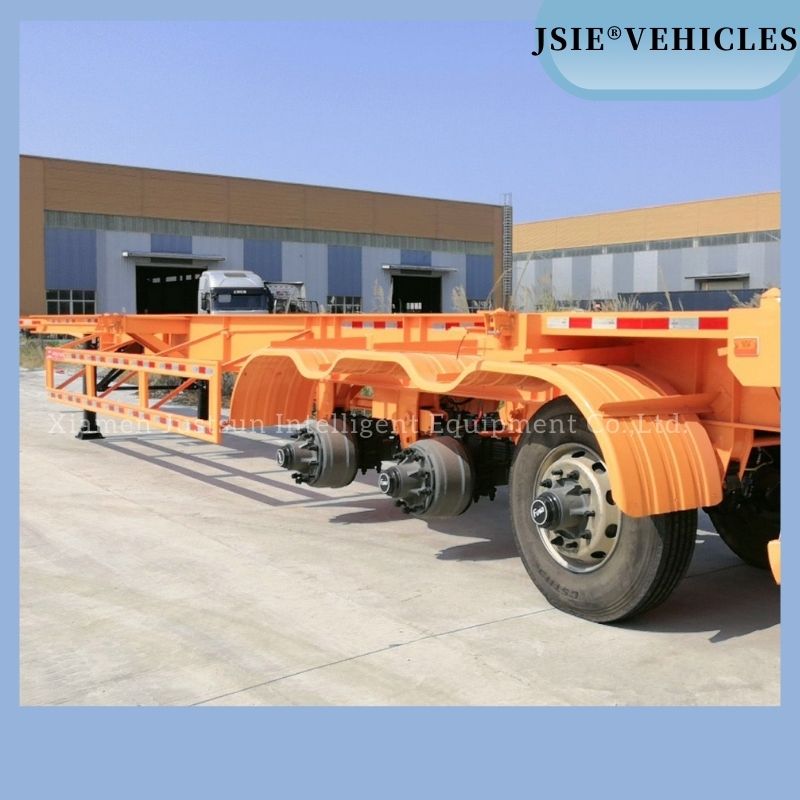
Skeleton trailers utilize a bare-chassis architecture. Manufacturers construct them using high-strength steel main beams and sturdy cross members. They position heavy-duty twist locks directly onto this framework. The design entirely omits a solid loading deck.
This lack of a deck represents a highly intentional engineering choice. It creates a dedicated container semi trailer. You get a machine optimized purely for securing and hauling standardized ISO shipping containers. Without a floor, the trailer sheds redundant materials. The bare frame provides maximum vertical strength exactly where the container's corner castings rest.
Flatbed trailers feature a solid floor installed over the main chassis. Manufacturers typically build this deck from steel checker plate, extruded aluminum, or treated wood like apitong. The deck spans the entire length and width of the trailer.
To accommodate shipping containers, engineers integrate retractable or pop-up twist locks into the deck structure. These specialized locks raise up when you need to secure a container. They sit completely flush inside the floor when you haul non-containerized bulk freight. This flush design ensures pallets, steel coils, or lumber can slide across the deck without snagging. However, these moving lock mechanisms add considerable mechanical complexity to the trailer.
Trailer weight directly impacts container hauling legality. Every pound your trailer weighs is a pound you cannot legally bill to a customer. We must analyze the direct financial impact of tare weight differences.
Flatbed trailers carry a severe weight penalty. The solid deck requires substantial supporting cross-members. Depending on the flooring materials, a flatbed deck adds roughly 1 to 2+ tons to the trailer's total tare weight. Heavy hardwood or thick steel plating pushes this penalty even higher.
This extra tare weight directly subtracts from your maximum legal payload capacity. Transport regulations enforce strict gross vehicle weight limits. If your trailer weighs an extra 4,000 pounds, your maximum cargo weight drops by exactly 4,000 pounds. This penalty becomes a critical failure point when hauling heavily laden containers filled with liquids, machinery, or dense agricultural goods. Pushing past the limit leads to severe overweight fines at highway weigh stations.
A standard 40FT skeleton trailer aggressively strips away non-essential weight. By removing the floor and extra deck reinforcements, it offers an incredibly lean tare weight. High-density cargo operations benefit immensely from this lightweight profile.
You comply much more easily with strict local axle-weight limits. Drivers can accept heavier inbound containers from seaports without fearing compliance violations. This lean design ensures you maximize billable freight weight on every single trip. Over a fiscal year, hauling an extra ton of payload per trip generates massive revenue increases.
Fleet utilization defines logistics profitability. Idle assets and deadhead miles destroy profit margins. You must address the business problem of empty return trips when choosing between these two designs.
Flatbed trailers dominate mixed-freight environments. Consider a scenario where a fleet hauls an imported container inbound to a manufacturing facility. Once the facility unloads the container, the driver faces a choice. A skeleton trailer must drive back empty. A flatbed trailer provides a different option.
The driver can drop the empty container at a depot, fold down the retractable twist locks, and immediately load steel pipes, lumber, or palletized freight for the outbound leg. Flatbeds act as an insurance policy against empty return trips. They allow dispatchers to secure backhaul revenue. For independent owner-operators or regional fleets, this versatility guarantees continuous cash flow.
Skeleton trailers excel in dedicated route utilization. They dominate high-frequency, closed-loop container drayage. Imagine a truck running continuous loops from a seaport terminal to a nearby distribution center. The driver picks up a full container, drops it off, grabs an empty one, and returns to the port.
In this closed-loop scenario, the trailer only ever moves containers. If you deploy a flatbed for this route, you make a costly mistake. You pay a higher purchase price for a deck you never use. You haul tons of dead deck weight daily. A bare skeletal chassis represents the most efficient, streamlined tool for dedicated container loops.
Smart procurement requires a clear, skeptical evaluation of long-term financial commitments. You must look past the brochure and analyze acquisition, upkeep, and daily running costs.
Compare the average purchase prices directly. Skeletons are inherently less material-intensive. They require less steel, less welding time, and absolutely no flooring materials. Consequently, they generally cost significantly less upfront. Fleets can acquire more skeleton units for the same capital budget compared to buying fully decked flatbeds.
Aerodynamic drag aggressively impacts fuel burn. Flatbed trailers present a large, solid surface area. Even when unloaded, the bulky profile and solid deck create significant wind resistance. Skeleton trailers offer a highly streamlined profile. When unloaded, air flows freely through the bare chassis. This reduced aerodynamic drag, combined with the lower dead weight, yields measurable diesel savings over long highway transit miles.
Container transport involves moving tall, top-heavy steel boxes at high speeds. You must evaluate the risk management aspects of trailer design.
Skeleton trailers often allow containers to sit slightly lower to the ground. The container rests directly on the main structural beams. This marginal drop in height significantly improves cornering stability. It lowers the entire rig's center of gravity. High-deck flatbeds inherently push the container higher into the air. When navigating tight highway off-ramps or sudden evasive maneuvers, the high-deck flatbed experiences increased body roll. The lower stance of a skeletal frame actively reduces rollover risks.
Heavy-duty fixed twist locks define skeleton trailer security. Manufacturers weld these locks directly into the rigid frame bolsters. They contain no complex internal springs. They offer brute-force reliability. Flatbeds rely on dual-purpose retractable locks. While versatile, these moving parts can accumulate road grit. If a retractable lock fails to deploy fully, the container rests unevenly, creating a severe load securement hazard.
Port compliance dictates daily efficiency. Highly automated or stringent ports often prefer specific chassis types. Rapid loading operations utilize massive gantry cranes and automated straddle carriers. These machines expect standard skeletal frames. Some terminal operators mandate bare chassis for safety reasons. An overhead crane operator can visually confirm fixed twist-lock engagement much easier on a bare skeletal frame than on a wide, cluttered flatbed deck.
Making the final choice requires matching mechanical realities to your specific business model. Use this direct shortlisting guide to summarize the evaluation criteria.
| Evaluation Criteria | Skeleton Trailer | Flatbed Trailer |
|---|---|---|
| Primary Freight Type | Exclusive ISO Containers | Mixed Cargo & Containers |
| Tare Weight Impact | Ultra-light (Maximizes Payload) | Heavy (Reduces Payload) |
| Backhaul Capability | None (Containers Only) | Excellent (Pallets, Steel, Lumber) |
| Maintenance Needs | Low (Chassis & Brakes Only) | High (Deck & Retractable Locks) |
The procurement decision ultimately hinges on the ratio of your container-exclusive transport versus your general freight requirements. Neither trailer is objectively inferior. They simply serve different logistical blueprints. A dedicated container loop demands the lightweight efficiency of a skeletal frame. A volatile, mixed-freight route demands the backhaul flexibility of a solid deck.
A: Yes, provided the trailer is equipped with the correct middle twist-lock configurations. Manufacturers install specialized retractable locks in the center of the deck to secure two separate 20ft boxes. However, you must meticulously adhere to total axle weight limits, as two fully loaded 20ft containers easily exceed maximum legal highway weights.
A: You primarily see 2-axle and 3-axle options on the market. While 2-axle models work for lighter loads or specific regional regulations, 3-axle configurations remain the global standard for 40ft and 45ft heavy containers. A 3-axle setup effectively distributes extreme weight to ensure legal highway compliance and better braking performance.
A: For overhead gantry cranes, the lifting process is identical. However, the alignment phase requires slightly more precision on a flatbed. Crane operators must ensure the retractable locks are perfectly raised and engaged. If alignment fails, the container might rest unevenly on the solid deck, creating immediate securement issues.