Telephone/WhatsApp: +86-13950097655 E-mail: eric@justsuntrucks.com
Please Choose Your Language

- All
- Product Name
- Product Keyword
- Product Model
- Product Summary
- Product Description
- Multi Field Search
Views: 0 Author: Site Editor Publish Time: 2026-08-11 Origin: Site
Asking how many axles a trailing unit has seems like a simple trivia question. The standard answer usually sounds straightforward. However, the operational implications run much deeper. These configurations dictate your payload capacity. They also influence legal compliance and overall fleet profitability. To eliminate any ambiguity, we must first distinguish the front power unit from the trailing unit itself. You cannot evaluate one effectively without understanding the other. This article provides fleet managers and owner-operators an actionable framework. We will help you evaluate various semi trailer axle configurations. You will learn how to balance specific freight requirements against strict weight regulations. We will also explore long-term maintenance expenses. Choosing the correct setup ensures you maximize revenue per mile. You will avoid unnecessary overweight fines. Ultimately, this knowledge helps reduce excessive wear on your expensive commercial equipment.
A standard semi-trailer typically features 2 axles (tandem), bringing the total for a standard 18-wheeler tractor-trailer combination to 5 axles.
Axle configurations directly dictate legal gross vehicle weight limits (e.g., the 80,000-pound federal standard) under the Federal Bridge Gross Weight Formula.
Specialized freight requires multi-axle semi trailers (3+ axles) to distribute heavy loads, but these introduce higher maintenance, toll, and tire costs.
Evaluating axle setups requires balancing maximum payload revenue against long-term operational friction and regional compliance variations.
Many people use the terms "truck" and "trailer" interchangeably. This creates confusion when counting wheels and analyzing equipment. We need to clarify the terminology immediately. The power unit is the tractor. It pulls the heavy freight. The trailing unit holds the actual cargo.
Let us look at the power unit first. A standard heavy-duty tractor features three distinct axles. You have one steer axle at the front. This directs the vehicle and holds two wheels. Behind the cab, you find two drive axles. They provide the necessary traction. Each drive axle holds four wheels.
Now, consider the standard trailing unit layout. A typical configuration places two axles at the rear. Industry professionals call this a standard tandem setup. Each of these rear axles holds four wheels.
If you do the math, the classic 18-wheeler layout makes perfect sense. You combine three tractor axles and two trailer axles. This equals five total axles. The tractor holds 10 wheels. The trailing unit holds eight wheels. Together, they create the iconic 18-wheel footprint on the highway.
Why does this five-axle setup remain the business baseline? It offers an optimal physical balance. Drivers enjoy excellent maneuverability in tight shipping yards. Fleets maintain legal compliance under the standard 80,000-pound federal weight limit. It works perfectly for general dry van operations and standard reefer logistics.
Different freight demands require completely different equipment. Manufacturers build trailing units in several standard layouts. Each layout serves a very specific logistical purpose.
Closed Tandem Axles
This represents the most common layout on the road today. The manufacturer spaces the two rear axles approximately 40 inches apart.
Features-to-Outcomes: This close spacing makes the entire unit highly maneuverable. Drivers can easily back into standard warehouse loading docks. It serves as the ideal choice for standard less-than-truckload (LTL) shipments and full truckload freight.
Spread Axle (Split Tandem) Trailers
Heavy loads often require better physical weight distribution. Spread axles solve this exact problem. The manufacturer spaces these axles at least 10 feet apart.
Features-to-Outcomes: Federal regulations treat these widely spaced axles individually. Each axle can legally carry 20,000 pounds. This creates a combined 40,000-pound rear capacity. A standard closed tandem only allows 34,000 pounds total.
Use Case: You see this setup often on flatbeds and step decks. Drivers need extra flexibility when balancing heavy, indivisible industrial items.
Tri-Axle and Multi-Axle Trailers
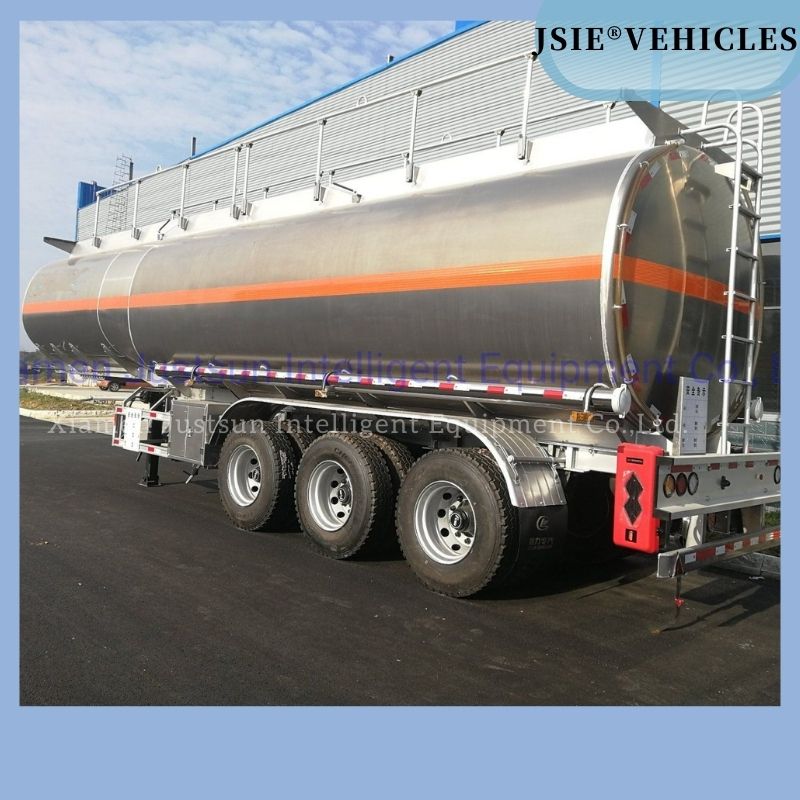
Certain construction jobs demand extreme payload capacities. Fleet operators turn to specialized multi-axle semi trailers. These robust units feature three, four, or even more rear axles.
Features-to-Outcomes: Adding more axles drastically increases your legal payload capacity. The extra wheels distribute massive weight over a much wider surface area.
Use Case: Heavy-haul companies use these for massive machinery. You also see them hauling raw aggregates and specialized oversize loads.
Lift Axles (Drop Axles)
Sometimes you need extra structural support. Other times, you run completely empty. A drop axle provides mechanical adaptability.
Features-to-Outcomes: Drivers can raise this extra axle when hauling light loads. This simple action saves significant fuel and reduces tire wear. When fully loaded, the driver lowers the axle. This adjustment ensures immediate weight compliance for a heavy semi-trailer.
Understanding axle counts requires understanding strict federal law. The Federal Bridge Gross Weight Formula dictates your legal operations. This core regulatory framework protects our vulnerable national infrastructure. It prevents heavy vehicles from destroying bridges and cracking highways over time.
The rule dictates a very simple mathematical concept. You must distribute total vehicle weight over a specific number of axles. You must also maintain specific physical distances between those axles. More axles spaced further apart allow for heavier legal loads. Concentrating too much weight in a small area causes point-load damage to the pavement.
The federal government strictly enforces maximum capacities across interstate highways. You must memorize these baselines.
Axle Group Location | Maximum Legal Weight Limit (lbs) |
|---|---|
Steer Axle (Front Tractor) | ~12,000 |
Tractor Drive Tandems | 34,000 |
Trailer Rear Tandems | 34,000 |
Total Legal Gross Vehicle Weight | 80,000 |
Compliance realities hit fleet operators incredibly hard. Overweight fines quickly destroy narrow profit margins. Violating these weight limits triggers severe financial penalties. Department of Transportation scales monitor these weights constantly.
If you operate multi-axle setups, you will face route restrictions. Many local municipal roads cannot handle specialized heavy-haul equipment safely. You must secure specialized permits for overweight loads. These permits cost extra money and require careful administrative route planning.
Adding more axles definitely increases your maximum payload capacity. However, you must evaluate the hidden mechanical trade-offs. Selecting units boasting more than standard tandem configurations significantly changes your daily operating expenses.
Toll Road Expenditures: Toll authorities usually charge operators by the axle. A tri-axle or quad-axle setup incurs predictably higher routing costs. You will pay more money at every single toll gantry.
Tire Wear and Maintenance: Spread axles cause severe tire scrub. During tight turns, the tires drag laterally across the harsh pavement. This lateral dragging shreds rubber tread very quickly. Furthermore, multi-axle setups multiply your basic maintenance checklist. You must buy more brake pads, air suspension components, and replacement tires annually.
Fuel Efficiency: Additional axles increase aerodynamic drag under the chassis. They also increase rolling resistance against the asphalt. Your fleet fuel economy will inevitably drop.
ROI Calculation: Buyers need a highly transparent decision framework. You must ask a crucial operational question. Does the premium rate charged for heavier specialized payloads offset the increased maintenance? You must calculate this operational friction before purchasing specialized heavy-haul equipment.
Choosing the perfect logistics equipment requires careful historical data analysis. You must align your hardware choices directly alongside your commercial growth goals.
First, assess your typical freight density. Are you constantly maxing out your legal weight capacity? Industry veterans call this "weighing out." If so, you definitely need a multi-axle setup. Conversely, do you fill the physical trailer space before hitting the weight limit? People call this "cubing out." If you haul lightweight foam or empty plastic containers, standard tandems work perfectly.
Second, evaluate your primary geographic operating regions. Bridge laws vary drastically between neighboring states and provinces. Some jurisdictions offer generous spread-axle allowances. Others strictly penalize them during inspections. You must research the specific highway corridors your drivers travel most frequently.
Configuration Type | Primary Operational Benefit | Best Freight Match | Financial Implication |
|---|---|---|---|
Closed Tandem | Maximum urban maneuverability | General dry van / LTL loads | Lowest baseline maintenance costs |
Spread Axle | Flexible heavy load balancing | Heavy steel coils / lumber | High tire replacement frequency |
Tri-Axle | Maximum gross payload capacity | Aggregates / heavy machinery | Highest toll and fuel expenses |
Do not ignore internal driver training requirements. Maneuvering spread axles through tight urban environments requires advanced driving skill. Novice drivers easily damage curbs and tires. Operating lift-axle air controls requires specific pneumatic knowledge. Drivers must know exactly when to deploy drop axles to remain compliant during sudden inspections.
Take actionable steps today before expanding your fleet. Audit your current load board opportunities carefully. Compare those lucrative loads against your current equipment limitations. Procuring a new or leased unit makes financial sense only if consistent freight volume justifies the mechanical upgrade.
Standard configurations typically feature two rear axles, but your ideal number depends entirely on your specific commercial logistics application.
Profitable fleet scaling requires aligning your chosen hardware directly alongside your most consistent freight types.
You must balance regional weight regulations against your long-term mechanical maintenance budgets.
Consult directly alongside a commercial dealership or fleet spec engineer to match hardware perfectly against your daily operational constraints.
A: Yes, single-axle trailers are extremely common in specific logistics sectors. People often call them 28-foot "pup" trailers. Less-than-truckload (LTL) operations use them extensively. Drivers commonly pull these smaller, highly maneuverable units in double or triple train configurations across major interstate highways.
A: Payload capacity depends heavily upon specific axle spacing and regional state regulations. A standard tri-axle group can typically carry up to 42,000 or 42,500 pounds safely. This specialized setup allows for much higher gross vehicle weights if you secure the proper heavy-haul permits.
A: Spread axles offer a much larger margin of error when loading heavy, single items. Flatbed drivers frequently haul dense freight like steel coils. Regulators treat each widely spaced axle individually at 20,000 pounds. This proves much easier than balancing weight perfectly across a single 34,000-pound tandem group.
A: Generally, yes. If the drop axle remains in the down or deployed position while passing through a toll gantry, authorities count it. You will pay for that extra axle. However, electronic tolling systems and enforcement rules vary significantly from state to state.