Telephone/WhatsApp: +86-13950097655 E-mail: eric@justsuntrucks.com
Please Choose Your Language

- All
- Product Name
- Product Keyword
- Product Model
- Product Summary
- Product Description
- Multi Field Search
Views: 0 Author: Site Editor Publish Time: 2026-08-25 Origin: Site
Loading a flatbed improperly triggers immense financial and operational stakes. Department of Transportation (DOT) fines, severe cargo damage liability, and accelerated equipment wear routinely plague fleets. Many operators ignore precise loading protocols. Flatbed loading is never simply a physical task. It is a critical risk-management process. Operators must strictly adhere to weight distribution physics. They must also follow complex Federal Motor Carrier Safety Administration (FMCSA) securement mandates.
When fleet managers standardize load protocols, they actively prevent out-of-service violations. They protect their heavy-duty investments from premature failure. In this guide, you will learn the exact physics of flatbed weight balance. We will explore how to evaluate securement options properly. You will also discover how modern load planning software guarantees compliance. Following these step-by-step loading processes protects your workers and preserves your equipment.
Proper weight distribution (targeting a 50/50 balance) minimizes axle strain and ensures weigh station compliance.
The aggregate Working Load Limit (WLL) of all securement devices must equal at least 50% of the cargo’s total weight.
Evaluating and matching specific load securement options (chains, synthetic webbing, edge protectors) to the cargo type is critical for preventing load shifts.
Adopting 3D load planning software can eliminate manual calculation errors, maximize deck space, and reduce weigh station delays.
You must place the heaviest items in the center of the deck. This basic rule maintains steering control. It also prevents dangerous rollovers during transit. When you position heavy cargo too far forward, the tractor's steer tires bear excessive weight. This makes steering sluggish. If you place heavy items too far back, the drive tires lose traction. A centered load keeps the center of gravity low. It equally distributes forces across the entire rig.
The DOT strictly enforces axle weight limits. Standard limits dictate 12,000 pounds for steer axles. Drive axles allow 34,000 pounds. Trailer axles also allow 34,000 pounds. Operators face major risks if they overload specific axles. This happens even if the total gross weight remains legal. The Federal Bridge Formula dictates how weight must spread across axle spacings. Shorter wheelbases require lower maximum weights. You must calculate these variables carefully to avoid bridge damage and subsequent fines.
Lateral imbalance creates massive operational risks. Uneven weight distribution causes rapid, uneven tire wear. It also inflicts severe suspension damage on semi trailers. When one side carries more weight, the suspension air bags compensate unevenly. This continuous strain degrades the chassis. It also dramatically increases the likelihood of a rollover on highway curves.
Scale tickets frequently reveal early miscalculations. Drivers often discover axle overloads at the weigh station. Reworking a load at a scale is expensive and dangerous. It wastes valuable hours of service. Initial precision is entirely critical. You must calculate distribution before the forklift ever touches the cargo.
The FMCSA enforces strict securement rules. You must understand the Working Load Limit (WLL) of your gear. The total aggregate WLL of all tie-downs must equal at least 50% of the cargo weight. If a load weighs 40,000 pounds, your combined tie-down WLL must reach 20,000 pounds minimum. Always read the manufacturer tags on your equipment. Unmarked gear defaults to the lowest legal rating.
Different cargo demands different securement tools. Synthetic webbing, commonly called straps, works best for lumber. Straps also secure PVC pipes and delicate materials perfectly. You should evaluate straps based on tension retention. Check their UV resistance regularly. Sun exposure degrades synthetic fibers over time.
Conversely, Grade 70, 80, or 100 chains provide raw holding power. Chains are necessary for heavy machinery. You must use them for steel coils and sharp-edged cargo. Evaluate your chains based on their strength-to-weight ratio. Lighter, higher-grade chains reduce driver fatigue during securement.
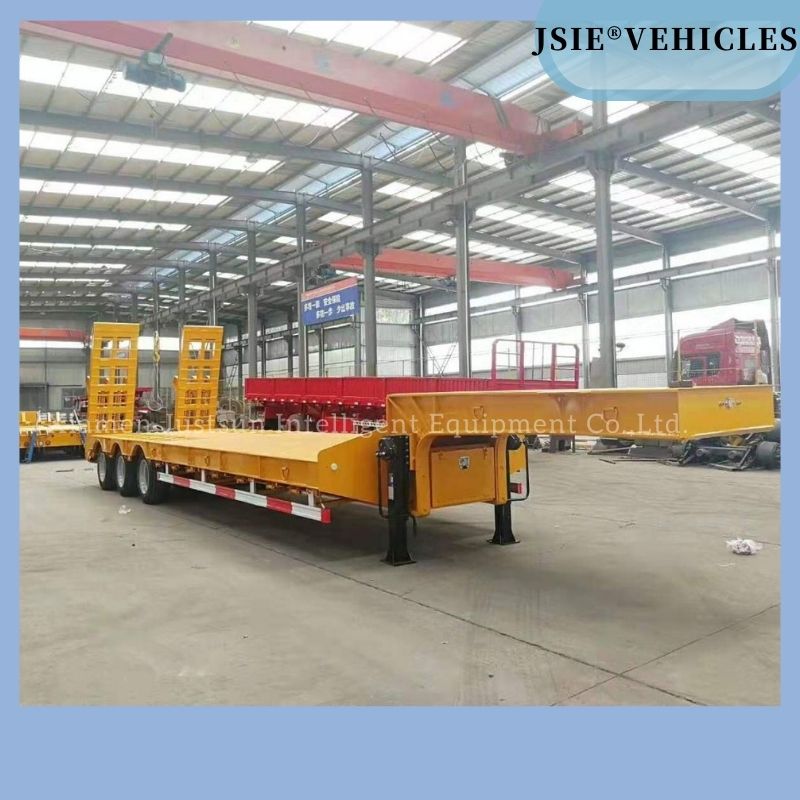
When loading a specialized semi-trailer, matching the chain grade to the heavy load prevents catastrophic failures.
Securement Type | Best Cargo Applications | Primary Advantage | Key Limitation |
|---|---|---|---|
Synthetic Straps | Lumber, PVC, Pallets, Delicate Cargo | Protects cargo surface, lightweight | Susceptible to UV damage and cuts |
Grade 70 Chains | Heavy Machinery, Steel Coils, Logs | High durability, resists sharp edges | Heavy, causes driver fatigue |
Grade 100 Chains | Extreme Heavy Haul, Oversized Loads | Highest strength-to-weight ratio | Higher initial procurement cost |
Edge protectors serve a vital dual purpose. They protect fragile cargo from strap compression damage. More importantly, they protect the strap from sharp cargo edges. A sharp steel corner easily slices a synthetic strap under tension. V-boards distribute the strap's pressure evenly. This extends the lifespan of your securement gear significantly.
Anti-slip friction mats offer an excellent cost-to-benefit ratio. These mats dramatically increase the friction between the deck and the cargo. Higher friction reduces the forward movement potential. In many FMCSA scenarios, using friction mats reduces the total number of required tie-downs. This saves time and minimizes equipment wear.
Never load a compromised deck. Establish a strict baseline checklist for inspecting your equipment before loading begins.
Inspect the main deck for rotting wood or compromised aluminum planks.
Check all winch tracks for cracks or bends.
Verify the structural integrity of every stake pocket.
Examine D-rings for rust, deformation, or loose welds.
Clean the deck surface to remove oil, ice, or debris.
A thorough inspection of your semi trailer ensures securement devices anchor properly.
Clear communication prevents dock accidents. Establish best practices for guiding forklift operators. Use standardized hand signals for overhead crane operators. Ensure operators place loads gently. Dropping heavy cargo fractures deck cross-members. Plan the loading sequence carefully. Guide the forklift to place the heaviest items precisely on the trailer's center line.
Working at height remains the primary risk of flatbed operations. Drivers routinely climb onto decks to throw straps. You must evaluate and mitigate these fall hazards.
Install mobile fall protection systems in your loading bays.
Use trailer-mounted safety rails during the loading process.
Implement strict "no boots on deck" policies wherever operational realities allow.
Provide specialized tools for placing edge protectors from the ground.
Manual load planning invites costly errors. Using spreadsheets or simple guesswork fails for complex loads. Mixed-freight flatbed shipments require precise geometry and weight mathematics. Manual calculations often ignore the subtle shifts in the center of gravity. This guesswork leads to frequent scale violations. It forces drivers to return to the dock for readjustments.
Modern 3D load software transforms fleet operations. These digital tools provide two massive advantages.
First, they offer spatial optimization. The software maximizes available deck space. It ensures you never violate federal overhang regulations. You can visualize the exact placement of odd-shaped cargo.
Second, they provide instant weight distribution metrics. The system automatically calculates individual axle weights. You know the exact steer, drive, and trailer axle weights before the forklift ever touches the cargo.
Fleet operators easily justify the cost of load planning software. The return on investment appears quickly across several operational metrics. You will see significantly reduced out-of-route miles. Drivers no longer detour to commercial scales just to check legal limits. Your fleet incurs fewer DOT fines for weight violations. Furthermore, loading dock turnaround times plummet. Forklift drivers follow a digital map instead of waiting for manual directions.
Your hardware dictates your loading strategy entirely. Standard flatbeds handle typical freight perfectly. They offer a uniform deck height for standard lumber and steel. Step decks, or drop decks, lower the center of gravity for taller loads. This drop permits higher cargo heights without hitting bridge clearances. Lowboys sit even closer to the ground. They transport massive construction equipment. The lower the deck, the lower the center of gravity. This dramatically improves transit stability.
Suspension systems influence cargo shock absorption directly. Air ride suspensions provide a cushioned transit environment. They absorb road vibrations effectively. This protects sensitive machinery and prevents securement straps from loosening. Spring ride suspensions offer rugged durability. However, spring rides transfer more kinetic energy to the cargo. You must check strap tension more frequently when hauling on spring ride suspensions.
Proactive fleet management requires continuous hardware evaluation. Audit your current fleet against your most common freight types. Identify where operational bottlenecks occur. Do your drivers constantly fight height restrictions? A step deck upgrade makes sense. Do you haul fragile items on spring rides? Transitioning to air ride prevents cargo damage claims. Match your equipment specifications to your daily freight realities.
Loading a flatbed safely demands strict discipline. It requires a flawless combination of correct equipment and deep regulatory knowledge. You must build standardized operational frameworks for your team. Targeting a perfect weight balance protects your axles and keeps you legal. Using the correct securement gear prevents catastrophic load shifts on the highway.
Take action today by auditing your current securement gear. Discard any straps or chains showing excessive wear. Standardize your weight distribution checklists across your entire terminal. Finally, evaluate 3D load planning technology. Upgrading your digital tools and specialized equipment eliminates guesswork and secures your fleet's long-term profitability.
A: A standard flatbed typically carries a maximum payload of 48,000 pounds. This limit depends heavily on the tractor's empty weight. The federal gross vehicle weight (GVW) limit for the entire combination is 80,000 pounds. You must subtract the truck and trailer's empty weight from 80,000 to determine the exact legal payload capacity.
A: The FMCSA dictates specific tie-down quantities based on length and weight. You need one tie-down for articles 5 feet or less weighing under 1,100 pounds. You need two tie-downs for articles between 5 and 10 feet. Add one additional tie-down for every 10 feet of length thereafter.
A: Federal standards generally allow up to 3 feet of overhang on the front. They allow up to 4 feet of overhang on the rear. If your cargo exceeds these dimensions, you must obtain specialized oversized load permits. You must also use required safety flagging and specialized lighting.
A: Steel coils require specialized FMCSA compliance. You must use certified heavy-duty coil racks. You must place friction mats under the racks and coils. Chains route through the coil eye using specific patterns. These patterns include suicide (eye facing sides), shotgun (eye facing front/back), or eye-to-the-sky (eye facing up) configurations.