Telephone/WhatsApp: +86-13950097655 E-mail: eric@justsuntrucks.com
Please Choose Your Language

- All
- Product Name
- Product Keyword
- Product Model
- Product Summary
- Product Description
- Multi Field Search
Views: 0 Author: Site Editor Publish Time: 2026-08-12 Origin: Site
Fleet operators face a constant operational hurdle today. You must maximize payload capacity while strictly following complex federal and state weight laws. Balancing these demands requires reliable equipment and precise load management.
A tandem axle serves as the backbone of modern freight transport. We define it concisely as a paired set of axles placed directly behind one another on a commercial truck or trailer. Manufacturers design this specific setup to disperse heavy load weights safely across the pavement. Selecting the correct axle configuration directly impacts your fuel efficiency, maintenance overhead, and legal compliance.
We will explore how tandem configurations operate in the real world. You will see how they compare to alternative axle setups. Finally, we provide a clear evaluation framework to help you spec your next heavy-duty asset accurately.
Definition: A tandem on a semi trailer consists of two closely spaced axles that work together to support and distribute payload weight across a wider footprint.
Compliance Factor: Sliding tandems allow operators to shift weight between the tractor's drive axles and the trailer axles to comply with Federal Bridge Gross Weight Formula regulations.
Configuration Choice: Tandem setups excel in heavy, variable-weight freight, whereas single axles offer fuel and maintenance savings for consistent, lightweight loads.
Maintenance Realities: Sliding mechanisms introduce specific wear points (locking pins, rails, air lines) that require documented preventative maintenance to avoid roadside violations.
Understanding the physical differences between tandem setups helps you match equipment to your operational needs. The industry relies heavily on two primary configurations. Each serves a distinct purpose based on freight predictability.
Manufacturers weld fixed tandems directly to the chassis of the trailer. This permanent attachment eliminates moving parts within the suspension base. You will typically find fixed configurations on specialized flatbeds or heavy-haul equipment. Operations utilizing these trailers manage highly predictable load positioning. Structural rigidity remains paramount when hauling oversized or dense industrial equipment. By eliminating the sliding mechanism, you reduce mechanical complexity and improve overall structural integrity.
Sliding tandems operate differently. Technicians mount these axles on a movable track, known as a rail, located beneath the trailer body. This dynamic system allows the driver to move the rear axles forward or backward along the rail. When the driver engages the release mechanism, they can reposition the suspension box to redistribute weight effectively.
This flexibility delivers significant business value. It enables fleets to accept diverse loads by dynamically adjusting weight distribution on the fly. You avoid rejecting lucrative shipments. You also minimize the risk of incurring severe overweight fines at weigh stations. A well-maintained sliding tandem makes a single trailer versatile enough to handle varying pallet weights and irregular freight patterns.
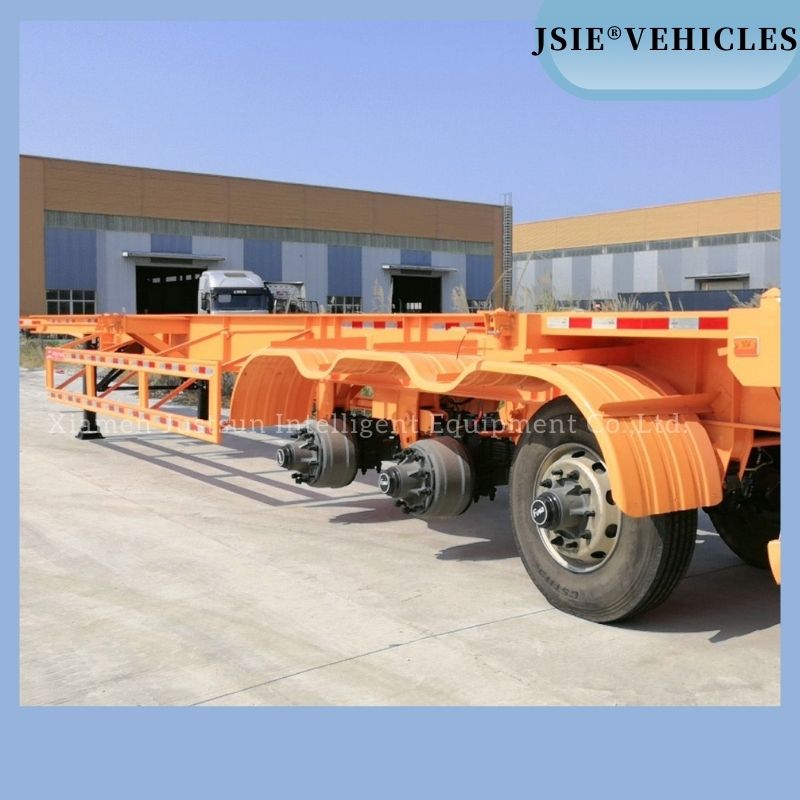
Terminology in the trucking industry often confuses new professionals. Clearing up these definitions ensures better communication between dispatchers, drivers, and maintenance crews. It also prevents costly spec'ing errors when ordering your semi trailers.
We must dispel a common terminology mix-up. A "tandem" refers exclusively to the two physical axle shafts positioned together. It dictates the structural framework supporting the trailer. "Duals" refer to the tire arrangement. Duals mean you have two tires bolted together on each end of an individual axle. Therefore, a standard tandem setup features eight tires in total. Four tires sit on the front axle, and four sit on the rear axle. You can have a single axle with duals, but you cannot have a tandem without two distinct axles.
Choosing between a single axle and a tandem axle changes how you operate. You must weigh payload requirements against efficiency metrics.
Payload Capacity: Federal law limits a single axle to 20,000 lbs. Conversely, a tandem axle supports up to 34,000 lbs. This significant difference dictates what types of freight you can legally haul.
Operational Efficiency: Single axles generate noticeably less rolling resistance. They push fewer tires against the pavement. They also incur lower toll fees on many turnpikes because tolling authorities often charge per axle.
Shortlisting Logic: You should specify single axles for predictable, light freight operations. Parcel delivery networks and beverage distribution routes benefit greatly from single axles. You should specify tandems for over-the-road dry vans, refrigerated units (reefers), and fluctuating freight contracts where payload weights change daily.
Feature | Single Axle | Tandem Axle (Fixed) | Tandem Axle (Sliding) |
|---|---|---|---|
Federal Weight Limit | 20,000 lbs | 34,000 lbs | 34,000 lbs |
Tire Count (Standard) | 4 | 8 | 8 |
Primary Application | Light freight, LTL | Heavy-haul, flatbeds | OTR dry vans, reefers |
Weight Redistribution | None | None | High (via rail adjustments) |
Moving freight across state lines exposes drivers to strict regulatory enforcement. DOT officers monitor axle weights aggressively. A proper semi trailer configuration keeps you out of the penalty box.
Federal guidelines cap the gross vehicle weight of a standard commercial truck at 80,000 lbs. However, you cannot simply load 80,000 lbs randomly. The law mandates specific distribution limits across the vehicle footprint. A standard breakdown looks like this: you can place 12,000 lbs on the steer axle. You can place 34,000 lbs on the tractor's drive axles. Finally, you can place 34,000 lbs on the trailer tandems. Exceeding any of these individual limits results in a violation, even if your gross weight remains under 80,000 lbs.
The Federal Bridge Gross Weight Formula exists to protect highway infrastructure. Bridges can only handle so much concentrated stress. The formula dictates that the distance between axles matters just as much as the actual weight. Spreading the weight over a longer distance prevents concentrated damage to the bridge deck. This regulation dictates exactly where you must position your sliding tandems. Moving the axles further back spreads the weight over a longer wheelbase, satisfying the formula for heavier loads.
Federal rules set the baseline, but state-specific laws add complexity. States often implement maximum length laws to ensure vehicles can safely navigate local intersections. For example, California enforces a strict 40-foot kingpin-to-rear-axle rule. This mandate requires the distance from the kingpin to the center of the rear axle to measure 40 feet or less. You must slide the tandems forward before crossing the California border. Failing to adjust your semi-trailer to meet these local variations leads to immediate citations.
Adjusting tandem axles requires precision and focus. Drivers must follow strict safety protocols to prevent equipment damage and personal injury.
Executing a tandem slide involves a standardized operating procedure. You must train drivers to handle this process methodically.
Park on a level surface: Always perform adjustments on flat, stable ground. Pull the tractor-trailer forward in a straight line.
Set the trailer brakes: Engage the trailer parking brakes from the cab. Keep the tractor brakes released.
Release the locking pins: Exit the cab and pull the release handle located near the tandems. Some modern units feature pneumatic release valves operated from the dashboard. Ensure all four pins retract fully from the rail holes.
Adjust the tractor position: Carefully reverse the tractor to push the trailer back (sliding tandems forward). Alternatively, pull the tractor forward to slide the tandems backward. Move slowly.
Re-engage and verify pins: Push the manual handle back in or flip the pneumatic switch. Gently rock the tractor back and forth until you hear the pins click into the new rail holes. Visually inspect all four pins to ensure they seat completely through the rail.
Drivers use a standard rule of thumb to calculate adjustments quickly. Moving the tandem one hole on the rail shifts approximately 250 to 400 lbs of weight. If you slide the tandems backward, you shift weight onto the tractor's drive axles. If you slide the tandems forward, you transfer weight back onto the trailer axles. You use this math to balance the load accurately after visiting a commercial scale.
Improper sliding procedures create severe safety hazards. The most common driver error involves failing to ensure all locking pins seat fully. If a driver hits the highway with unseated pins, the entire axle assembly can slide violently during hard braking. This sudden axle shifting destabilizes the trailer, potentially causing a catastrophic loss of control.
Heavy loads exert massive stress on suspension components. You must monitor wear patterns proactively to keep assets moving safely.
Tandem axles face unique tire degradation challenges. When a driver executes a tight turn, the forward motion fights against the fixed geometry of the two closely spaced axles. This creates "tire scrub." The tires drag laterally across the pavement rather than rolling smoothly. This scrubbing action accelerates tread wear significantly compared to single axles. You must maintain proper tire inflation and perform regular tread depth inspections to mitigate uneven wear.
The sliding mechanism demands rigorous upkeep. Slider rails accumulate dirt, grease, and road debris. Locking pins experience high shear forces every time the trailer stops. You must lubricate the slider rails frequently to ensure smooth operation. You also need to inspect pneumatic release valves closely. In winter climates, road salt and frozen moisture often cause manual and pneumatic pins to seize. A seized pin forces a driver to delay their route while attempting to hammer the mechanism free manually.
The type of suspension system impacts overall durability. You generally choose between air-ride and spring-ride suspensions. Air-ride systems utilize airbags to absorb road shock. They provide superior cargo protection for fragile freight and reduce vibration damage to the trailer structure. Spring-ride systems rely on heavy steel leaf springs. They handle dense, rugged loads well but transmit more shock into the chassis. Evaluating these options helps you match the suspension style to the realities of your freight environment.
Procuring new equipment requires a strategic look at your daily operations. You must match the physical capabilities of the trailer to your dispatch realities.
You need to assess what your fleet prioritizes most. Do you require maximum load flexibility to accept diverse backhauls? If so, robust sliding tandems represent a core necessity. Do you run dedicated, predictable routes with lightweight cargo? In that scenario, heavy tandem configurations might introduce unnecessary mechanical complexity.
Review these operational questions before finalizing your specifications:
Do your routes cross strict bridge-law states? If your trucks frequently travel into states with aggressive kingpin rules, you require sliding tandems to remain compliant across borders.
Are you hauling dense, heavy materials? Freight like lumber, steel, or industrial liquids demands tandems. You might even evaluate closed-tandem or specialized spread-axle configurations for extreme weights.
Are you primarily hauling volume-outs? If your freight cubes out (fills the trailer volume) long before it weighs out (hits maximum legal weight), you should evaluate single axle viability for maintenance simplicity.
We advise consulting with an equipment specialist before committing to a purchase. You should audit your current freight profiles, review historical weigh station data, and analyze typical route geographies. This data-driven approach guarantees you specify the exact axle setup your operation needs.
A tandem axle represents far more than a simple structural necessity for heavy loads. It serves as a dynamic tool for maintaining regulatory compliance and ensuring route profitability. Mastering the differences between fixed and sliding setups gives your dispatchers and drivers a distinct operational advantage.
Choosing the right configuration requires a highly transparent assessment of your typical freight weights. You must understand your operational routes and evaluate your shop's maintenance capabilities honestly. Proper spec'ing reduces roadside delays and prevents costly DOT violations.
We encourage you to review available equipment matching your specific payload requirements. Contact a knowledgeable fleet sales representative today to request a custom specification audit for your next trailer acquisition.
A: Federally, a standard tandem axle configuration can legally carry up to 34,000 pounds. You must distribute this weight evenly across the axles to remain compliant during DOT scale inspections.
A: Closed tandems are spaced close together, typically measuring 49 to 60 inches apart. Spread axles usually sit 10 feet apart. The DOT treats spread axles as two distinct single axles, allowing up to 20,000 lbs per axle, yielding 40,000 lbs total.
A: Drivers slide tandems to balance load weight legally between the tractor's drive axles and the trailer axles. They also slide them to comply with state-specific maximum length laws regarding the distance from the kingpin to the rear axle.
A: Yes. Sliding tandems to the very rear worsens aerodynamics and increases the turning radius. This negatively impacts fuel efficiency. Positioning them as far forward as legally allowable typically yields much better MPG.