Telephone/WhatsApp: +86-13950097655 E-mail: eric@justsuntrucks.com
Please Choose Your Language

- All
- Product Name
- Product Keyword
- Product Model
- Product Summary
- Product Description
- Multi Field Search
Views: 0 Author: Site Editor Publish Time: 2026-08-10 Origin: Site
Navigating massive commercial vehicles through tight urban spaces demands more than just highly skilled driving. It requires an exact understanding of vehicle geometry and spatial dynamics in motion. Miscalculating the turning capabilities of heavy vehicles leads to costly infrastructure damage, severe liability risks like right-turn squeeze accidents, and deeply inefficient routing. Evaluating commercial transport equipment requires moving beyond simple static dimensions to truly understand the dynamic footprint of an articulated vehicle in motion. A failure to map this correctly causes bottlenecks and endangers public safety. This article provides route planners, fleet managers, and safety coordinators with an authoritative breakdown of essential turning metrics. We will explore critical operational variables, specific mechanical configurations, and local safety compliance frameworks. You will learn how to optimize fleet maneuverability, match equipment to your operational environment, and actively prevent expensive intersection collisions.
The turning circle of an articulated truck is not a single line; it is a "swept path" determined by the tractor's outer front tire and the semi trailer's inner rear tire.
A standard heavy-duty tractor paired with a 53-foot semi-trailer typically requires a minimum turning radius of 45 to 55 feet, depending on the wheelbase and kingpin setting.
"Off-tracking" (where the rear wheels follow a shorter path than the front wheels) is the primary cause of urban routing liabilities and loading dock collisions.
Fleet procurement must balance volumetric cargo capacity against maneuverability constraints dictated by operational environments.
Fleet planners often confuse turning radius and swept path. Understanding the distinction is vital for safe routing. Commercial vehicles do not pivot on a single point. They articulate. We use three specific metrics to define how these vehicles maneuver through physical space.
Defining the Turning Radius: This is the baseline circular arc. The tractor's outermost steering tire creates this arc during a maximum-lock turn. It dictates the absolute minimum space the prime mover needs to reverse direction.
Understanding the Swept Path (Turning Path): This measures the actual ground area covered by the entire vehicle. It highlights the critical gap between the tractor's outer path and the trailer's inner trajectory. You must account for this entire swept area to prevent collisions.
Swing Clearance Explained: This involves the outward arc of the front and rear overhangs during a turn. When drivers execute sharp maneuvers, the rear tail swings outward into adjacent lanes. This metric is crucial for evaluating obstacle clearance.
Why do planners need this evaluation lens? Relying solely on the tractor's turning radius creates critical blind spots. Facility planning falls apart when you ignore the trailer's dynamic footprint. Risk assessment models must incorporate the full swept path. Most modern semi trailers demand far more internal turning space than their tractors imply.
Infrastructure design relies heavily on standardized templates. The Department of Transportation uses baseline models to guide highway and intersection construction. Fleet managers must align equipment choices with these physical constraints.
The 40-foot to 53-foot range dictates typical minimum baseline requirements. A 53-foot unit represents the standard for U.S. highway transport. It offers maximum cargo volume but requires expansive intersection geometry. Urban delivery standards often favor smaller units to mitigate off-tracking limits.
Consider the 18-wheeler U-turn reality. A standard configuration generally requires at least three full lanes to execute a continuous 180-degree turn. You need roughly 60 or more feet of horizontal clearance. Attempting this maneuver in narrower spaces guarantees property damage or traffic blockages. Drivers physically cannot bend the equipment tighter than the steering geometry allows.
Industry standardization solves many routing headaches. Engineering templates guide loading dock construction, terminal gates, and intersection design. Civil engineers use standard profiles to ensure massive vehicles can safely enter and exit logistics hubs without destroying curbs. Planners must match fleet assets to these standardized facility templates.
Trailer Length | Typical Intersection Turning Radius | Approximate Swept Path Width | Ideal Operational Environment |
|---|---|---|---|
28-Foot (Pup) | Under 40 Feet | Narrow | High-density urban delivery |
40-Foot | 40 to 45 Feet | Moderate | Mixed industrial and urban routing |
48-Foot | 45 to 50 Feet | Wide | Regional distribution centers |
53-Foot | 50 to 55+ Feet | Maximum | Long-haul highway transit |
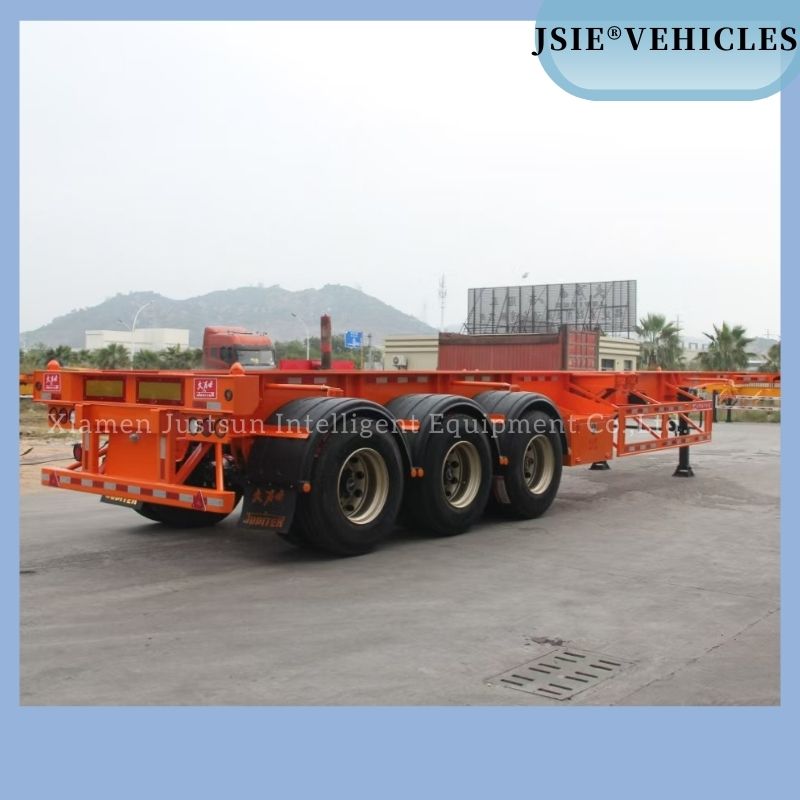
Maneuverability depends heavily on specific mechanical settings. A semi trailer does not behave uniformly across all fleets. You can adjust several variables to alter the turning circle drastically.
Kingpin-to-Rear-Axle Distance: This is the most critical dimension affecting maneuverability. A shorter distance reduces off-tracking significantly. However, it alters weight distribution across the axles. Regulators heavily monitor this distance to protect bridge infrastructure.
Tractor Wheelbase and Steering Angle: The prime mover's physical length impacts the initiation of the turn. A long-wheelbase tractor needs a wider initial swing. The maximum wheel-cut angle also dictates how sharply the cab can pivot before hitting the trailer.
Tandem Axle Positioning: Sliding tandems impact the turning circle immediately. Moving axles forward decreases the turning radius. It makes the unit pivot sooner. However, it increases the rear overhang swing, pushing the tail dangerously into adjacent lanes.
Challenging Assumptions: Planners often hold the misconception that shorter trailers always turn easily. They ignore tractor-level adjustments. A short trailer paired with a stretched sleeper cab still suffers from poor agility in tight urban confines.
Understanding these variables helps fleets spec equipment correctly. Drivers must understand their axle settings before navigating complex city blocks. Proper axle placement ensures regulatory compliance while minimizing spatial friction.
Tight turns expose fleets to immense legal and physical dangers. Off-tracking creates hazardous situations in shared traffic spaces. When a vehicle articulates, the driver loses visibility over certain spatial zones.
The right-turn squeeze represents the greatest blind spot risk. The mechanics of off-tracking cause units to cut corners sharply. They can crush smaller vehicles or pedestrians caught on the inside of a turn. This happens when car drivers underestimate the swept path and attempt to pass on the right side. Juries often hold fleets strictly liable for these predictable squeeze accidents.
Infrastructure damage carries massive hidden expenses. Clipped curbs, damaged street signage, and loading dock wear-and-tear drain maintenance budgets. Misaligned specs cause vehicles to scrape terminal walls daily. These minor impacts degrade structural integrity over time. Municipalities aggressively fine fleets for destroying city property during difficult turns.
Compliance and route legality tie directly to turning capacities. Municipal restrictions on vehicle length exist for spatial reasons, not arbitrary rules. City engineers limit 53-footers on certain blocks because the intersections cannot accommodate their swept paths. Violating these length laws leads to stranded vehicles, heavy citations, and forced towing.
Risk mitigation requires proactive strategies. Fleets utilize convex mirrors and advanced sensor arrays to manage blind spots. Drivers need rigorous training to master the physical realities of the swept path. They must learn the "button-hook" technique to square off turns safely. Technology and education work together to prevent catastrophic spatial errors.
Procurement choices dictate operational success. You cannot buy equipment based solely on cargo volume. You must evaluate the operational friction a semi-trailer might face daily.
Matching equipment to the environment requires a strict shortlisting criteria. Long-haul highway routes demand different specs than final-mile urban deliveries. Highway runs prioritize aerodynamic efficiency and maximum cube space. Urban routes prioritize short wheelbases and tight turning capabilities. Sending highway equipment into dense urban grids guarantees operational failure.
You face a constant capacity versus agility trade-off. Balancing the need for a 53-foot high-cube unit against older industrial parks causes friction. Older facilities were built for 45-foot or 48-foot units. Their yard space and dock spacing cannot handle modern highway units. You must assess customer facility limitations before standardizing your fleet length.
Implementation considerations involve specialized hardware. Specialized hauling environments might dictate custom kingpin settings. Lift axles reduce drag when empty and alter the effective wheelbase. Steerable axles dramatically reduce off-tracking on heavy-haul units. These engineering solutions cost more upfront but prevent constant routing delays.
Next-step actions start with your own facilities. Begin auditing current yard space and dock spacing immediately. Plot the swept paths needed for your targeted equipment. Do not commit to a standardized fleet length until you map the spatial reality of your primary routes.
Fleet Priority | Equipment Strategy | Primary Benefit | Spatial Drawback |
|---|---|---|---|
Maximum Cargo Volume | 53-Foot, Fixed Axles, Long Tractor | Highest load capacity per trip | Massive swept path and off-tracking |
Urban Agility | 28-Foot or 40-Foot, Day Cab | Access to narrow streets/docks | Requires more trips for high volume |
Specialized Heavy Haul | Steerable Trailer Axles, Custom Kingpin | Handles extreme weights flexibly | High complexity and maintenance |
Mixed Operations | 48-Foot, Sliding Tandems | Balances volume and maneuverability | Requires driver adjustment per route |
The turning circle represents a dynamic, shifting metric. Axle placement, tractor wheelbase, and driver execution heavily influence it. Relying on simple linear dimensions invites severe operational risks and infrastructure damage. The swept path dictates how a vehicle interacts with the physical world. Understanding this spatial reality separates efficient fleets from dangerous ones.
We recommend aligning trailer specifications strictly with your primary delivery routes. Ensure your procurement teams talk to your safety coordinators. Map out the structural realities of your loading facilities before buying new assets. Train your drivers to understand swing clearance and off-tracking variables perfectly. Smart planning today prevents devastating squeeze accidents and costly routing bottlenecks tomorrow.
A: A standard heavy-duty tractor pulling a 53-foot unit typically requires a minimum turning radius of 45 to 55 feet. Executing a standard 90-degree intersection turn smoothly requires considerable space. The driver must swing wide into adjacent lanes to keep the rear trailer tires from mounting the inside curb.
A: A standard configuration generally needs over 60 feet of horizontal clearance to complete a continuous 180-degree U-turn. This roughly equals three full highway lanes. The massive space requirement accommodates the wide swept path and severe off-tracking variables inherent to articulated vehicles.
A: Yes. Sliding the tandem axles forward shortens the effective wheelbase. This creates a sharper turn and reduces the inner swept path. However, it simultaneously increases the rear swing clearance. The back of the trailer will swing much wider outward, creating hazards in adjacent lanes.
A: Off-tracking is the physical difference between the path taken by the tractor's steering axles and the path of the trailer's rear axles. During cornering, the rear wheels pull inward, following a much shorter and tighter path. This mechanical reality causes inner-turn collisions if miscalculated.