Telephone/WhatsApp: +86-13950097655 E-mail: eric@justsuntrucks.com
Please Choose Your Language

- All
- Product Name
- Product Keyword
- Product Model
- Product Summary
- Product Description
- Multi Field Search
Views: 0 Author: Site Editor Publish Time: 2026-07-05 Origin: Site
Operating independently of port infrastructure and third-party cranes requires specialized equipment. For fleet operators managing heavy logistics, selecting the right heavy-duty vehicle is a high-stakes capital decision. You simply cannot afford missteps when building out your commercial fleet. Purchasing the wrong chassis can strand assets and drain operational budgets.
Logistics models have rapidly shifted recently. Many fleets moved away from relying purely on standard skeletal trailers. Now, they favor self-loading trailers known as sidelifters. These units empower operators to handle ground-level drops autonomously. You no longer need to wait hours for hired lifting equipment to arrive on site.
This comprehensive guide provides an objective, spec-driven framework. It helps you evaluate structural integrity, lifting capacity, and regional legal compliance before purchasing. You will learn exactly how to match chassis specs to your daily operational loads. Read on to discover which technical specifications truly dictate performance in the field.
Financial strategy drives heavy equipment procurement. Relying on standard skeletal trailers requires hiring mobile cranes at every drop-off point. Mobile crane rentals incur hourly minimums, travel fees, and unpredictable scheduling delays. Investing in a specialized container lifting and transport semi trailer shifts this dynamic entirely. Fleet managers convert variable rental expenses into a predictable capital asset.
Operational autonomy represents the primary advantage. Drivers can drop off or pick up fully loaded containers directly at customer sites. They never wait for external lifting equipment to arrive. This independence drastically reduces turnaround times at congested industrial zones. A single driver handles the entire loading, transport, and unloading cycle autonomously. Fleets often double their daily delivery volume using this method.
However, operators must acknowledge specific risks and trade-offs. Hydraulic lifting systems demand high upfront capital investment. They also require rigorous preventative maintenance schedules. A self-loading unit is not the perfect solution for every logistics company. It serves best on decentralized, high-turnover routes. Fixed point-to-point routes running between fully equipped ports might not justify the extra hydraulic weight.
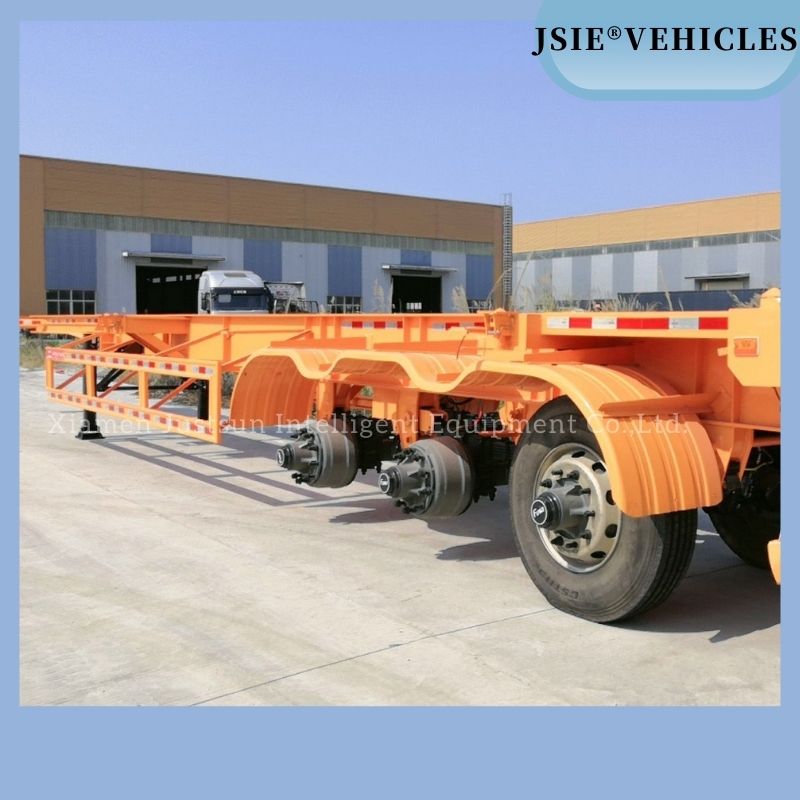
Selecting the correct chassis length defines your payload capabilities. Operators must match the trailer frame directly to the cargo density they haul most frequently.
High-density, heavy materials demand compact strength. Industries hauling bulk liquids, scrap metals, or construction aggregates typically prefer a dedicated 20FT container semi trailer. If you loaded these dense materials into a larger chassis, you would exceed Gross Vehicle Weight (GVW) limits long before filling the cubic volume.
You must evaluate specific structural specifications carefully. Inspect the main beam thickness, which handles localized stress. Verify the placement of the four primary twist locks. Short wheelbases provide excellent maneuverability in tight industrial zones. Drivers navigate narrow access roads much easier using a compact 20FT frame.
Volumetric goods require maximum deck space. Mixed logistics fleets often transport lighter retail goods or electronics. These fleets benefit immensely from a 40FT container semi trailer. A 40FT frame offers the flexibility to carry one large container or two tandem 20FT units simultaneously.
Evaluate the twist lock configurations first. A versatile 40FT chassis should feature between 8 and 12 twist locks. Assess the center-sag resistance, technically known as camber. A fully loaded dual-20FT configuration places massive downward force on the center span. The main beams must resist this deflection. Additionally, consider the wider turning radius required for 40FT navigation.
We must address a major safety assumption in the industry. Placing a single, heavily loaded 20FT container in the dead center of a standard 40FT trailer poses severe risks. The chassis requires specialized web reinforcement mid-span to prevent catastrophic structural failure. Never assume a standard 40FT frame can handle centralized point-loads without engineered bracing.
| Specification Category | 20FT Chassis Frame | 40FT Chassis Frame |
|---|---|---|
| Ideal Load Profile | High-density liquids, metals, heavy aggregates | Volumetric retail goods, tandem operations |
| Twist Lock Count | Typically 4 standard locks | 8 to 12 configurable locks |
| Maneuverability | Excellent tight-corner radius | Requires wide industrial access paths |
| Center Deflection Risk | Low (loads transfer directly over axles) | High (requires engineered camber) |
The mechanical lifting system forms the beating heart of your equipment. Understanding the nuances between marketing brochures and field performance prevents costly downtime.
Manufacturers often advertise maximum structural testing limits. A brochure might highlight a 45-ton theoretical limit. However, the practical daily Safe Working Load (SWL) typically hovers around 37 tons. You must design operations around the SWL, not the absolute maximum. Furthermore, lifting unbalanced containers is a daily reality. Liquids slosh during transport. Poorly packed cargo settles at one end. The hydraulic system must handle asymmetric loads smoothly without juddering.
You must choose between two primary power sources for the hydraulic pumps. Each presents unique maintenance profiles.
Stabilizers, or outriggers, prevent the trailer from tipping during a lift. Detail the required deployment width carefully. Maximum horizontal reach matters greatly. Unpaved or uneven industrial sites demand excellent ground pressure distribution. The outrigger footpads must spread the load over a wide surface area. If the footprint is too small, the outrigger will punch through soft asphalt, causing an immediate tip-over hazard.
Hydraulic flow rates dictate operational speed. Expect realistic loading or unloading times to range between 3 to 5 minutes per complete cycle. Faster cycle times rely on high-capacity hydraulic pumps. Consistent flow rates prevent jerky movements, protecting the fragile cargo inside the container.
Legal compliance determines operational viability. Purchasing a high-capacity machine means nothing if local authorities ground it for weight violations.
Lifting equipment inherently adds massive tare weight. Cranes, outriggers, and heavy-duty main beams often add 8 to 12 tons to the empty trailer weight. This dead weight directly impacts your maximum legal payload. You cannot carry the same heavy cargo inside the container as you would on a standard skeletal trailer. Fleet planners must calculate this penalty before dispatching loads.
Axle setups must offset the heavy crane machinery. Evaluate tri-axle versus quad-axle configurations based on your regional highway laws. Many jurisdictions strictly enforce axle weight distribution limits.
Lift axles and steering axles offer vital solutions. A lift axle reduces toll costs and tire wear during empty return trips. Steering axles prevent excessive tire scrubbing when turning heavy quad-axle units in tight yards. They protect your tire budget while maintaining legal compliance.
Transporting oversized loads introduces severe operational risks. You must clearly understand the legal limitations of transporting containers exceeding your chassis length. Rear overhang changes the swing radius of the trailer. It also alters the center of gravity. Buying the correct length chassis prevents costly fines and impoundments. Never compromise on frame length to save upfront costs.
Modern lifting trailers must incorporate failsafe technologies. Refuse to purchase equipment lacking these core interlocks:
Differentiating premium manufacturers from budget assemblers requires looking past the fresh paint. Material choices and component origins dictate the lifespan of the equipment.
Standard carbon steel belongs in the past. Premium manufacturers utilize high-tensile steel alloys, such as T700 or DOMEX. High-tensile steel features a much higher yield strength. This allows engineers to use thinner web plates without sacrificing structural integrity. Consequently, high-tensile steel reduces the overall tare weight significantly. Every ton saved in steel translates to an extra ton of legal payload revenue.
Inferior welding destroys heavy equipment. Chassis fatigue cracking remains the most common failure point in budget models. Look for manufacturers utilizing submerged arc welding. Inspect the facility for automated robotic welding stations. Robotic welds provide consistent, deep penetration along the entire main beam. Human error during manual overhead welding often leads to hidden micro-fractures under heavy cyclic loading.
The origin of critical wear parts tells you everything about a manufacturer's quality control. Evaluate the brands supplying the valves, pumps, and axles. Reputable tier-1 components indicate superior reliability. Look for WABCO braking valves and BPW or FUWA axles. Standardized components ensure your local mechanics can source replacement parts quickly. Proprietary, unbranded valves will strand your trailer for weeks waiting for overseas shipping.
When you contact manufacturers, guide the conversation using hard data. Use this three-point checklist when requesting your official quote:
Procurement success relies on objective data analysis. The right trailer balances autonomous lifting power against strict legal payload capacities. You must never sacrifice safety interlocks or steel quality to save initial capital. High-tensile frames and tier-1 hydraulic components always deliver superior returns over their operational lifespan.
Your final decision matrix remains straightforward. If you operate in tight spaces hauling dense materials, invest in a dedicated 20FT chassis. If you manage mixed logistics volumes requiring tandem deliveries, secure a reinforced 40FT chassis. Both options eliminate reliance on expensive mobile crane rentals.
Take immediate action today. Audit your current logistics routes and local axle weight limits. Calculate your annual external crane rental expenses. Use these localized figures to finalize your required chassis length and lifting tonnages. Proper planning guarantees your new fleet addition generates revenue from day one.
A: Yes, it can safely transport two 20FT containers. The trailer must feature 8 to 12 properly spaced twist locks. You must also ensure the combined cargo weight does not exceed legal gross vehicle limits. Furthermore, the chassis requires engineered camber to handle heavy mid-point stresses.
A: Standard side loaders handle ground-to-trailer or trailer-to-trailer transfers exclusively. They lack the geometry for high stacking. Stacking containers two-high requires specialized high-reach lifting arms. These extended arms drastically increase the tare weight and alter the tipping dynamics during operation.
A: Operators must conduct visual hose and valve inspections daily. Address any weeping seals immediately. You should replace the main hydraulic fluid every 1,000 to 2,000 hours of operation, or at least annually. Consistently greasing pivot pins prevents premature structural wear.
A: It depends entirely on the power source. If you utilize an independent Auxiliary Power Unit (APU) mounted on the trailer, any standard tractor works. If you rely on a Power Take-Off (PTO) system, your truck must feature a compatible hydraulic interface and heavy-duty PTO pump.