Telephone/WhatsApp: +86-13950097655 E-mail: eric@justsuntrucks.com
Please Choose Your Language

- All
- Product Name
- Product Keyword
- Product Model
- Product Summary
- Product Description
- Multi Field Search
Views: 0 Author: Site Editor Publish Time: 2026-07-07 Origin: Site
Logistics operators face a constant daily battle. They must balance equipment acquisition costs against the need for operational autonomy. The right trailer choice dictates terminal efficiency and long-term fleet returns. Fleet managers often struggle aligning trailing assets perfectly against varying client demands. Choosing between a self-loading asset and a standard chassis is rarely straightforward. Relying strictly on facility infrastructure severely limits your delivery versatility. Conversely, investing heavily in autonomous lifting equipment impacts payload capacity and strains maintenance budgets.
We will provide a transparent commercial evaluation comparing these two distinct transport assets. You will discover how they differ in payload economics, route efficiency, and deployment realities. You can then navigate equipment procurement confidently. Our comprehensive guide helps you select the exact equipment your dynamic logistics routes require to maximize profitability.
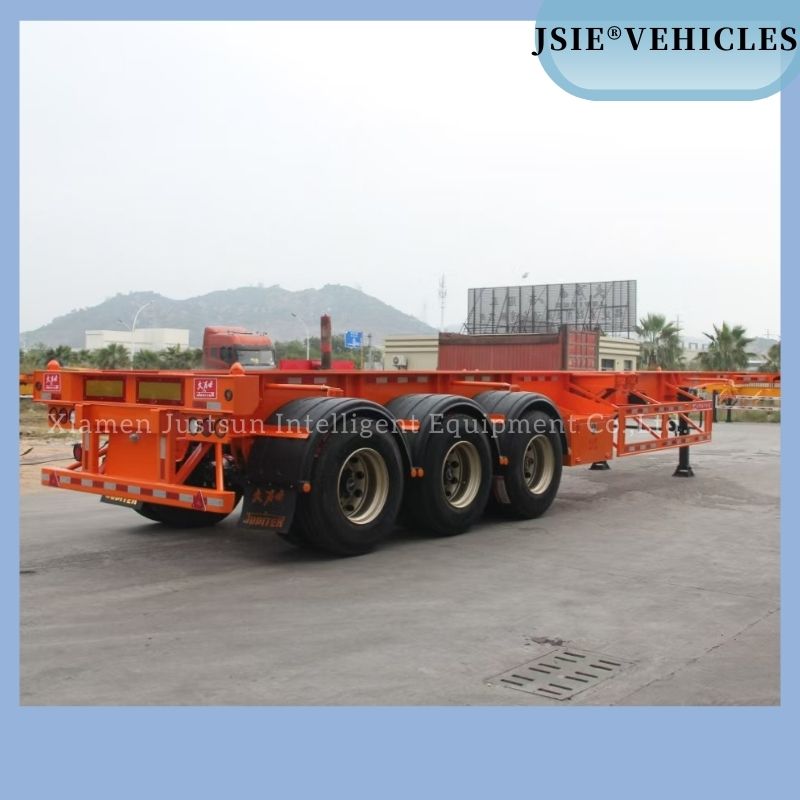
This design baseline represents the most fundamental approach to modern freight transport. Engineers build these assets around a stripped-down steel framework. They include specialized twist locks designed purely for secure transit. The structural simplicity removes unnecessary weight. Manufacturers utilize high-tensile steel to ensure structural integrity over millions of highway miles. These frames handle immense torsional stresses during transit.
However, this approach introduces strict operational dependency. The trailer possesses zero autonomous lifting capabilities. You must rely entirely on facility infrastructure for loading. Gantry cranes, heavy-duty forklifts, or reach stackers handle the box. If the destination yard lacks this machinery, you cannot unload the cargo.
The primary use case involves high-frequency, high-volume shuttle runs. Fleets deploy the skeleton container trailer between fully equipped logistics hubs. Port terminals and massive inland rail depots serve as ideal operational hubs. These environments guarantee rapid loading cycles. The trailer acts merely as a mobile platform between industrial nodes.
Best Practices for Skeleton Operations:
This specialized design baseline completely changes fleet capabilities. It integrates a heavy-duty chassis directly to onboard hydraulic crane modules. We commonly refer to this setup as a container side lifter trailer. It draws energy from the truck's PTO (Power Take-Off) system. Alternatively, many units feature an independent onboard diesel engine. The independent engine allows the trailer to operate regardless of the attached prime mover.
This architecture guarantees complete operational independence. Operators can ground containers smoothly in minutes. They can transfer boxes seamlessly to other trailers. High-capacity models even allow operators to double-stack boxes securely without external assistance. You control the entire handling process from the driver's seat.
The primary use case targets complex, decentralized logistics routes. Direct-to-client deliveries benefit immensely from this technology. Remote construction sites rarely feature heavy lifting infrastructure. Unloading heavy equipment or materials requires a container lifting and transport semi trailer to bypass expensive mobile crane rentals. Rail-yard transfers also become highly efficient when terminal handlers face backlogs.
Common Mistakes to Avoid:
Equipment weight directly dictates your revenue potential per trip. Highway regulations enforce strict gross vehicle mass limits globally. Every kilogram your equipment weighs reduces your allowable cargo.
The skeleton trailer offers an exceptionally low tare weight. These chassis typically weigh between 4.5 to 6 tons. Length and axle configurations cause minor variances. This lightweight nature allows fleets to maximize cargo weight efficiently. You can haul heavier commodities while remaining within legal bridge and road limits. Bulk agricultural goods and dense raw materials demand this specific chassis.
Conversely, lifting trailers face a significant tare weight penalty. The integration of hydraulic arms adds substantial mass. Stabilizer legs, reinforced mounting points, and power units further increase the bulk. These additions often increase the tare weight by 3 to 5 tons. This proportionately reduces the maximum legal cargo payload. You must calculate these limitations carefully before dispatching drivers. High-density cargo might push your gross vehicle weight beyond legal thresholds.
Payload and Tare Weight Comparison Chart
| Trailer Category | Average Tare Weight | Primary Weight Contributors | Relative Payload Capacity |
|---|---|---|---|
| Standard Skeleton Chassis | 4.5 - 6.0 Tons | Steel frame, axles, twist locks | Maximum legal allowance |
| Autonomous Lifting Trailer | 8.0 - 11.0 Tons | Hydraulics, outriggers, engine | Reduced by 3-5 Tons |
Physical space dictates where you can deploy these assets safely. Lifting trailers require specific lateral clearance alongside the vehicle. Operators must deploy stabilizer outriggers before lifting operations safely commence. These outriggers extend outward to create a secure, widened footprint. Ground bearing capacity must firmly support the massive outrigger point-load. Soft dirt or fresh asphalt can collapse under the immense pressure. Operators must carry reinforced dunnage pads to distribute this force safely.
Maneuverability remains a distinct advantage for basic chassis designs. Skeleton trailers require only a standard loading bay. Vertical clearance represents their only major spatial restriction. They remain highly efficient in tight, highly organized depot spaces. Drivers can back them into narrow alleys easily. They reverse into warehouse docks quickly. The absence of protruding hydraulic arms makes navigating urban industrial parks significantly safer.
Procurement budgets dictate the scale and pace of fleet expansion. Skeleton trailers represent a highly attractive, low barrier to entry. Their manufacturing simplicity keeps unit costs impressively low. This low acquisition cost allows transport companies to achieve rapid fleet scaling. You can purchase several basic chassis for the price of one specialized unit. Large carrier networks utilize this strategy to stage empty trailers across multiple client facilities.
In contrast, an autonomous lifting trailer acts as a major capital asset. Integrating advanced hydraulics and electronic controls drives up manufacturing costs. This equipment often costs three to five times more than a standard skeleton chassis. Securing financing requires a robust business case. You must prove the asset will generate consistent premium revenue. The steep initial outlay demands high utilization rates across specialized client contracts.
Daily running costs vary wildly between these two asset classes. Crane and terminal fees represent a massive burden for standard chassis operators. Every lift at a third-party depot drains your profit margin. Lifting trailers successfully bypass these third-party lifting fees entirely. This operational advantage can quickly offset their high initial CAPEX. If the trailer performs multiple groundings per week, the savings compound rapidly. Eliminating third-party crane rentals transforms the asset into a high-margin revenue generator.
Fuel consumption and wear patterns also diverge significantly. Skeleton trailers consume noticeably less fuel during highway transits. Their lower tare weight reduces engine strain and tire degradation. Lifting trailers consume more fuel during every transit mile. Furthermore, they require dedicated fuel to run the hydraulic power pack during operations. Fleet managers must account for these dual fuel burns when pricing delivery contracts.
Fleet uptime determines your monthly profitability. Skeleton trailers possess minimal moving parts by design. Maintenance is generally limited to greasing axles, adjusting brakes, and verifying twist-lock integrity. Mechanics can perform routine servicing rapidly. High uptime remains the absolute standard for these assets. Breakdowns rarely occur outside of standard tire or brake issues.
Lifting trailers introduce highly complex engineering into harsh environments. They utilize sensitive hydraulics and electronic control modules. High-stress structural pivot points require precise, frequent lubrication. Contaminated hydraulic fluid can destroy internal pump seals quickly. A single sensor failure can ground the entire asset instantly. Your maintenance department must possess specialized diagnostic skills. Stocking proprietary replacement parts becomes essential to prevent prolonged operational downtime.
Preventive Maintenance Focus Areas:
Human error poses severe risks when handling massive steel boxes. Skeleton operations require only standard commercial driving credentials. Once the driver secures the twist locks, their primary responsibility remains safe highway navigation. Training programs remain relatively brief and straightforward.
Lifting trailers require highly specialized operator certification. Drivers transform into crane operators upon reaching the destination. They must understand how to manage asymmetric loads safely. Wind-shear calculations become critical during lifting sequences. Incorrect outrigger deployment can flip the entire truck instantly. This reality raises human resource costs significantly. You must invest heavily in ongoing safety training programs. Retaining certified operators often requires premium salary compensation.
Selecting the optimal equipment requires an honest audit of your daily operations. You must align your capital investments directly against your most profitable routes.
Deploying specialized lifting assets allows you to dominate niche delivery markets. Standard chassis allow you to compete fiercely in high-volume, low-margin lanes. Evaluate your client base carefully before signing procurement orders.
The equipment choice is rarely about identifying superior technology. It remains entirely about operational alignment. Basic skeletal chassis win decisively on scale, mechanical simplicity, and sheer payload capacity. Autonomous lifting trailers win on route versatility, margin-capture per delivery, and total operational autonomy.
Fleet managers should conduct an immediate audit of their trailing 12-month terminal charges. Identify exactly how much revenue third-party lifting fees consume. Weigh those financial leaks against the higher acquisition costs and payload reductions of a self-loading asset. Use these insights to dictate your next strategic procurement decision. Aligning your hardware directly to your client needs guarantees sustained logistical profitability.
A: Standard Safe Working Loads (SWL) typically range from 37 to 45 tons. Specialized heavy-duty models can occasionally lift up to 50 tons. Operators must always verify the exact load rating before attempting lifts. Exceeding the specified SWL risks catastrophic structural failure.
A: Yes, they offer excellent compatibility. Most modern designs easily accommodate 20ft, 40ft, and 45ft units. They transport standard dry vans, high-cubes, ISO tanks, and heavy refrigerated units securely. You merely adjust the twist lock configurations to match the specific box dimensions.
A: It depends heavily on the chosen power configuration. PTO-integrated models require a specifically equipped prime mover to supply power. Independent diesel engine models offer total flexibility. Any standard prime mover can tow and operate an independent engine model seamlessly.
A: You can expect a significant weight discrepancy. The integrated cranes, massive outriggers, and heavy power units typically add 3 to 5 tons. Buyers must calculate this extra tare weight carefully. It directly reduces your maximum allowable highway payload capacity.