Telephone/WhatsApp: +86-13950097655 E-mail: eric@justsuntrucks.com
Please Choose Your Language

- All
- Product Name
- Product Keyword
- Product Model
- Product Summary
- Product Description
- Multi Field Search
Views: 0 Author: Site Editor Publish Time: 2026-07-06 Origin: Site
Operating a decentralized yard or managing last-mile container logistics often exposes a critical vulnerability. You constantly face the reliance on separate heavy-duty lifting equipment. Traditional logistics require a standard chassis for transport alongside a completely separate reach stacker, straddle carrier, or heavy forklift at both the origin and destination. This disjointed approach creates immediate equipment bottlenecks. It increases labor costs and extends turnaround times significantly.
Consolidating transport and lifting into a single asset fundamentally reduces third-party dependency. Evaluating this self-reliant solution requires looking past baseline specifications. You must understand ground conditions, throughput volume, and operational trade-offs to succeed. We will explore how these integrated systems operate in the field. You will discover how they compare to traditional handling methods. Finally, we will outline a strict procurement framework to ensure you make the most profitable fleet upgrade decisions.
Standardizing your fleet solely on a conventional container transport trailer assumes destination sites possess the necessary infrastructure to unload safely and quickly. This assumption often fails in off-dock yards or remote delivery nodes. When infrastructure falls short, costs escalate rapidly.
The primary bottleneck emerges from waiting for specialized loading equipment. Drivers frequently arrive at a destination only to wait hours for a site forklift or mobile crane to become available. This creates prolonged idle time for drivers and trucks, instantly lowering your overall fleet utilization. Trucks sitting in queues burn fuel and consume legal driving hours without generating revenue.
Establishing clear success criteria for efficiency remains vital. A successful handling upgrade must demonstrate a verified reduction in equipment touchpoints. It should require lower site infrastructure requirements, eliminating the need for expensive poured concrete pads. Ultimately, an effective upgrade delivers a measurable decrease in your overall cost-per-container-move.
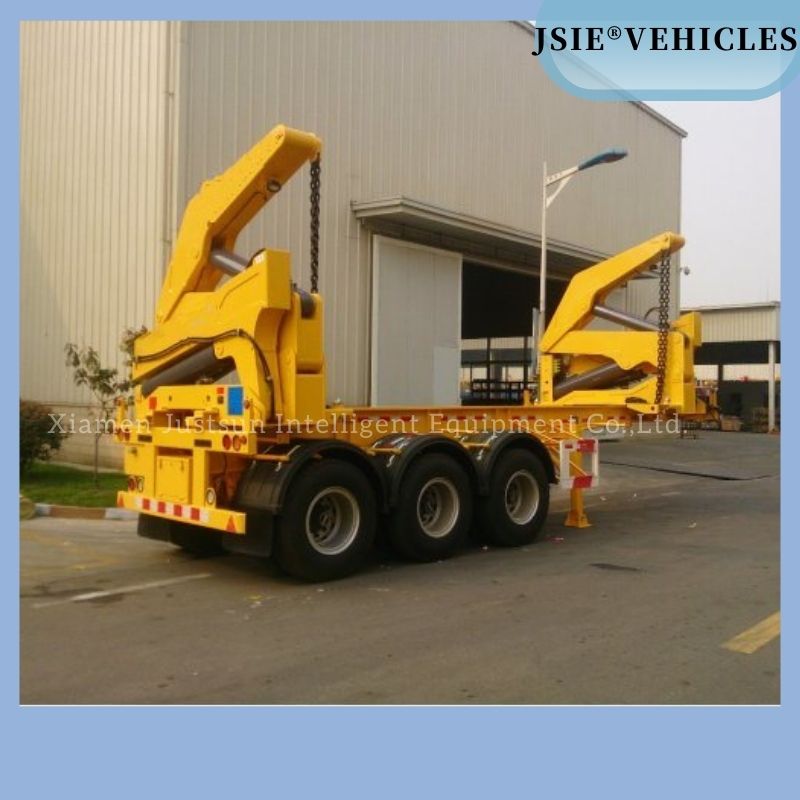
Integrated lifting systems resolve these bottlenecks through advanced engineering. A robust container lifting and transport semi trailer combines transit capabilities with heavy handling power. Often known as side lifters or self-loading trailers, these integrated systems utilize dual hydraulic cranes precisely mounted on the high-tensile steel trailer chassis.
The operational workflow guarantees independence and speed:
The efficiency gained fundamentally transforms logistics operations. You gain the ability to drop a container and leave immediately. This turnaround time reduction provides immense value versus waiting for live un-stuffing. Drivers unload the box, retract the cranes, and move swiftly to the next dispatch.
You must evaluate potential equipment based on your operational volume and site type. Treat this comparison as a strategic decision matrix.
Straddle carriers dominate high-throughput terminal environments. They process massive box volumes at busy seaports with incredible speed. However, deploying them requires massive upfront capital. You must also build reinforced ground infrastructure to support their immense localized tire pressure. Crane trailers serve a different purpose entirely. They cater to lower throughput operations. They remain highly mobile across public highways and require minimal site preparation.
Traditional heavy-duty forklifts require a substantial operational turning radius. Navigating a heavy forklift carrying a 40ft container demands vast paved areas. Furthermore, these machines require heavy-load bearing concrete to prevent severe surface damage. In contrast, crane trailers distribute weight efficiently through stabilized outriggers. This strategic weight distribution allows safe operation on compacted gravel or slightly uneven terrain.
| Equipment Type | Optimal Deployment Scenario | Required Ground Infrastructure | Public Road Mobility |
|---|---|---|---|
| Straddle Carrier | High-throughput port terminals | Deep reinforced concrete | Restricted to site limits |
| Heavy-Duty Forklift | Centralized warehousing hubs | High-grade industrial asphalt | Restricted to site limits |
| Self-Loading Trailer | Decentralized yards / Off-dock | Compacted gravel / standard dirt | Full highway compliance |
Procuring complex transport machinery requires strict technical evaluation. Fleet managers must investigate specific engineering dimensions beyond basic marketing brochures.
You must rigorously assess Lifting Capacity and Structural Integrity. Verify the maximum Safe Working Load (SWL) against your typical container weights. Ensure you check the lifting limits specifically for fully laden 40ft containers at maximum crane outreach. Chassis twisting under heavy loads indicates poor structural metallurgy.
Evaluating Hydraulic Reliability and the Component Ecosystem ensures long-term uptime. You should evaluate an XCMG crane semi trailer or similar tier-1 equipment for parts availability, pump efficiency, and global service networks. High-quality proportional valves provide the smooth, jerk-free movements essential for safe cargo placement.
Recognize the strict Tare Weight vs. Payload Trade-offs. Integrated cranes add significant tare weight to the trailer chassis. This added mass marginally reduces your maximum allowable payload on public roads under local weight compliance laws. Fleet operators must calculate these restrictions carefully.
Introducing active hydraulic equipment into a standard fleet changes your operational dynamics. Prepare your organization for these specific implementation realities.
The transition from a standard truck driver to a certified crane operator requires intensive focus. Your training programs must address specific physical dangers.
Acknowledge the major shift in workshop duties. You move from maintaining a basic static chassis to servicing complex hydraulics. Mechanics must now inspect PTO (Power Take-Off) units and troubleshoot electronic load sensors. You will need to stock replacement hydraulic filters, specialized seals, and high-pressure hoses.
The initial purchase price runs substantially higher than standard chassis models. Your financial justification relies strictly on documented labor savings. You must meticulously track reduced rental costs for localized lifting equipment. Profitability emerges when fleet managers leverage faster turnaround times to complete more daily runs per truck.
Upgrading your transport architecture demands systematic planning. Follow these actionable steps to shortlist the most effective handling solutions.
Execute a thorough Site Audit. Measure your current average unloading delay times precisely. Map the surface quality of your most frequent delivery nodes. If most destinations lack paved concrete, outrigger-equipped units become a functional necessity.
Determine your exact Throughput Thresholds. Assess if your TEU (Twenty-foot Equivalent Unit) volume truly justifies an integrated unit. If a single location handles hundreds of boxes daily, decentralized reach stackers remain mathematically sound. Conversely, self-loading units shine when moving moderate volumes across highly distributed locations.
Define uncompromising Vendor Requirements. When requesting manufacturer quotes, demand specific cycle-time data for full deployment and lifting. Request detailed preventive maintenance schedules. Above all, secure robust warranty coverage for the complex lifting mechanics, not just the steel transport chassis.
Integrating heavy-duty lifting capabilities onto the transport chassis fundamentally shifts operational bottlenecks. It moves logistical control from the destination site directly back to your fleet managers.
These integrated solutions do not serve as a replacement for high-volume terminal stackers. However, they act as the optimal bridge for mid-volume, decentralized logistics requiring absolute autonomy, flexibility, and speed.
A: Standard self-loading units typically feature maximum capacities ranging from 36 to 40 tons. They handle fully laden 20ft and 40ft ISO containers easily. Operators must always verify the specific Safe Working Load (SWL) at maximum crane outreach using the manufacturer's load chart.
A: Yes, many self-loading trailers possess stacking capabilities. They can typically stack containers up to two high. The exact stacking limit depends heavily on the specific crane model, hydraulic outreach limits, and the container sizes being handled.
A: The integrated dual cranes add substantial tare weight to the trailer frame. This naturally reduces the maximum payload you can legally transport on public roads. Fleet managers must carefully audit local axle-weight regulations to maintain compliance when hauling heavy cargo.
A: Routine maintenance requires daily visual checks of hydraulic hoses, locking pins, and outrigger pads. Mechanics must perform scheduled hydraulic fluid replacements and filter changes. Regular structural fatigue inspections on the lifting arms and chassis mountings remain critical for safety.