Telephone/WhatsApp: +86-13950097655 E-mail: eric@justsuntrucks.com
Please Choose Your Language

- All
- Product Name
- Product Keyword
- Product Model
- Product Summary
- Product Description
- Multi Field Search
Views: 0 Author: Site Editor Publish Time: 2026-07-05 Origin: Site
Are you a fleet manager or logistics director struggling to eliminate third-party crane rental costs? We know how frustrating extended turnaround times at drop-off sites can be. The transport industry is currently experiencing a fundamental shift. We are aggressively moving away from traditional chassis trailers toward highly autonomous self-loading systems. You might initially hesitate at the high upfront capital expenditure (CapEx) required for these specialized units. However, they consistently deliver unmatched long-term operational efficiency. They give your team complete control over delivery schedules and resource allocation.
This guide provides an objective framework for evaluating these advanced logistics assets. We will systematically explore equipment specifications, mechanical designs, and practical use cases. You will learn exactly how to assess different models to ensure they align perfectly with your daily freight demands.
You must understand the equipment objectively before adding it to your fleet. A container lifting and transport semi trailer is a specialized logistics unit. It strategically integrates a hydraulic crane directly onto a reinforced trailer chassis. This combination creates a fully autonomous loading and unloading system. Drivers can ground heavy shipping boxes without external machinery. The design focuses heavily on stability, power generation, and structural integrity.
Evaluating this equipment requires a close look at three primary structural components. These parts determine the lifespan and safety of the unit.
Always request the material data sheets for the chassis steel. Look for specific tensile strength ratings. Additionally, inspect the hydraulic hosing layout. Hoses should be well-protected from UV exposure and road debris. Exposed lines lead to premature failure and costly fluid leaks. Do not compromise on outrigger footpad sizes. Larger pads offer superior stability on uneven terrain.
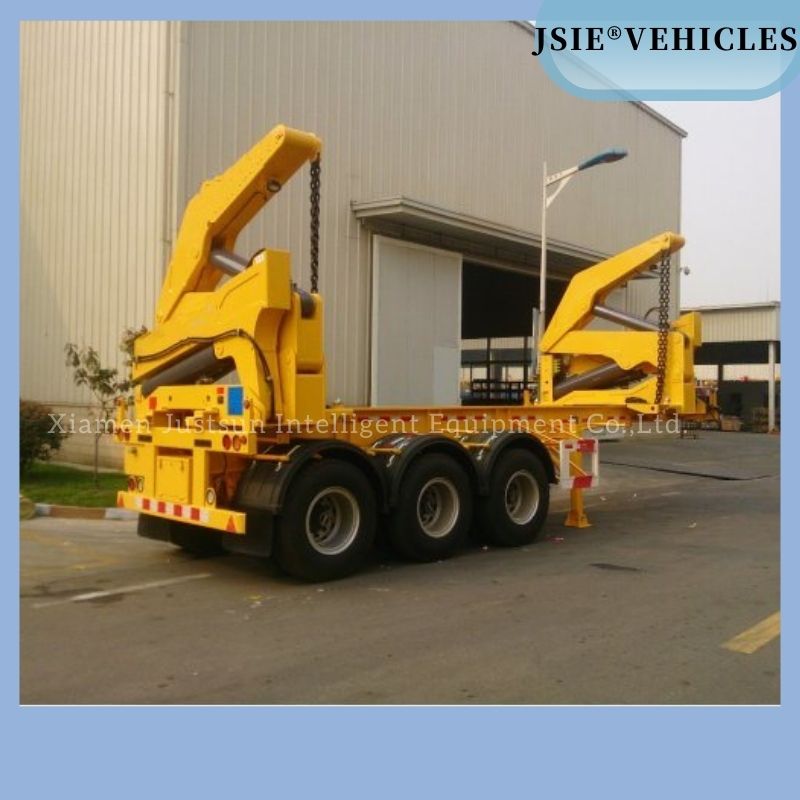
You will encounter two main mechanical approaches in the market. Each solves a slightly different logistical problem.
The side loader, often called a side lifter, lifts parallel to the chassis. It features two hydraulic arms positioned at the front and rear of the box. This design allows operators to lift boxes laterally and place them directly on the ground next to the trailer. It requires minimal overhead clearance. It excels in tight depot spaces.
Crane-mounted flatbeds take a different approach. They use a standard boom crane mounted behind the truck cab or at the rear of the trailer. This boom operates like a traditional knuckle boom. It offers more directional flexibility. However, it usually struggles with heavy 40ft boxes. The boom crane design is better suited for smaller 20ft units or mixed cargo.
Your fleet needs versatile equipment. Most modern lifting units handle standard 20ft, 40ft, and 45ft configurations. They use sliding or expanding chassis mechanisms to accommodate different lengths. You must lock the twist locks securely before initiating any lift.
You will frequently see the 45-ton capacity benchmark advertised. You must distinguish between theoretical maximums and Safe Working Loads (SWL). A 45-ton theoretical capacity might operate safely only up to 37 tons under daily, continuous stress. Always design your operational limits around the SWL. Pushing the equipment to its theoretical maximum daily accelerates metal fatigue and hydraulic wear.
Heavy hydraulic arms add significant tare weight. You must carefully assess axle configurations to ensure regional highway compliance. Bridge laws strictly dictate how much weight you can place on each axle.
A standard tandem-axle setup might suffice for lighter loads. However, tri-axle or quad-axle setups are standard for full 45-ton capacities. Extra axles distribute the combined weight of the heavy chassis, the crane, and the loaded box. Always consult your local Department of Transportation regulations before finalizing an axle specification.
| Design Element | Side Loader (Parallel Lift) | Boom Crane Mounted Flatbed |
|---|---|---|
| Primary Application | Heavy 40ft/45ft shipping boxes | Mixed cargo, 20ft boxes, building materials |
| Lifting Mechanism | Dual hydraulic arms (front and rear) | Centralized articulating knuckle boom |
| Overhead Clearance Needed | Minimal (lifts low and wide) | High (boom extends upward significantly) |
| Max Safe Working Load | Typically 37 to 45 Tons | Typically 10 to 20 Tons |
We should frame these applications as specific business problems solved. A standard container lifting semi trailer provides significant flexibility across various industries. It transforms how companies approach heavy logistics.
Many receiving facilities do not own reach stackers or heavy-duty forklifts. They rely on drop-and-hook operations or hire mobile cranes for the day. This dependency creates massive scheduling bottlenecks. A self-loading unit bypasses this problem entirely. The driver arrives at the facility. They deploy the outriggers. They ground the box safely in minutes. The driver then departs for the next job. The receiving facility can unpack the grounded box at their own pace. This independence eliminates demurrage fees and waiting time.
Standard heavy lifting infrastructure is non-existent in many locations. Mining camps, remote construction sites, and disaster relief zones lack paved staging areas. They certainly lack gantry cranes. A self-loading chassis excels here. The independent hydraulic system requires no external power grid. The truck navigates rough terrain to reach the site. The operator then carefully places the load exactly where site managers need it. This capability is crucial for delivering mobile generators, modular housing units, or heavy machinery parts.
Intermodal transport relies heavily on rail networks. Train schedules are rigid. Rail-mounted gantry (RMG) cranes are often overbooked. Trucks waste hours idling while waiting for RMG availability. Self-loading units solve this bottleneck. Drivers can pull alongside a train car (where yard rules permit) or a staging area. They can perform a direct transfer. This agile approach enables direct box grounding. It keeps the supply chain fluid even during peak yard congestion.
Large manufacturing campuses often move parts between distinct facilities. They operate massive inter-facility transit loops. These routes require constant movement. Waiting for a centralized yard crane stops the production line. Self-loading units streamline this process. Trucks can rapidly drop full boxes at assembly lines and immediately pick up empty ones. The autonomous nature of the equipment keeps the factory rhythm uninterrupted.
Upfront capital expenditure is high. You must evaluate the financial reality objectively. We can break down the numbers by looking at operational savings and hidden liabilities.
Imagine your current operation. You use a standard skeletal trailer. Every time you deliver a heavy box to a site without a forklift, you hire a mobile crane. You pay for the crane's travel time. You pay the crane operator's hourly rate. You also pay your truck driver to sit and wait for the crane to arrive.
Now, substitute that scenario with a self-loading unit. The truck arrives. The driver grounds the box autonomously. The job is complete. The savings multiply rapidly when you perform multiple drops per week.
| Cost Factor | Traditional Skeletal + Mobile Crane | Self-Loading Trailer System |
|---|---|---|
| Labor Required | Multiple personnel (Truck driver, crane operator, rigger) | Single operator (Truck driver with remote control) |
| Time per Drop | 2 to 4 hours (Includes waiting for crane arrival and setup) | 5 to 10 minutes (Autonomous drop) |
| Scheduling Complexity | High (Must align truck and crane schedules perfectly) | Low (Completely independent schedule) |
| External Rental Fees | High recurring expense per delivery | Zero external equipment fees |
We must present a balanced view. These units bring distinct operational challenges. The most significant issue is tare weight. The heavy steel chassis, hydraulic pumps, and massive lifting arms add substantial weight to your empty rig. This added tare weight reduces your maximum legal payload. You cannot carry as much freight inside the box before hitting highway weight limits. You must calculate your average cargo weight. Ensure it remains legally compliant when paired with a heavier trailer.
You also need to account for increased fuel consumption. Dragging a heavier trailer burns more diesel. Furthermore, hydraulic systems require meticulous maintenance. You will spend more on specialized hydraulic fluids, filters, and high-pressure hose replacements.
Adding this equipment to your fleet changes your daily operations. These are not plug-and-play assets. You must manage new safety risks and compliance demands.
Your standard commercial drivers cannot operate this equipment safely without additional instruction. Drivers require specific certifications for heavy hydraulic operation. They must understand load balancing deeply. A 40-ton box is rarely perfectly balanced. The center of gravity often shifts. Operators must know how to adjust hydraulic pressure proportionally. Most systems include wireless remote controls. This keeps the operator safely away from the drop zone. However, the operator still bears full responsibility for the lift's safety.
Hydraulic machinery operates under immense pressure. You must schedule strict preventative maintenance routines. Watch out for hydraulic seal wear. A blown seal during a lift causes catastrophic load drops. Monitor the PTO system for unusual vibrations or stress. Conduct structural fatigue inspections monthly. Look for micro-fractures near the outrigger mounting points and the main lifting arm joints. Catching a hairline crack early prevents fatal accidents.
Drivers cannot deploy outriggers blindly. Ground bearing pressure is the most critical safety factor. A fully loaded 45-ton lift exerts incredible downward force on the outrigger pads. Soft dirt, wet mud, or weak asphalt will collapse under this pressure. This collapse leads to immediate tip-overs.
Train your operators to follow these site assessment steps before every lift:
A self-loading chassis is a strategic investment. It heavily favors fleets prioritizing autonomy and fast turnaround times over maximum payload weight. You eliminate third-party rental bottlenecks completely. You empower your drivers to complete complex deliveries independently.
Before purchasing, carefully audit your most frequent delivery sites. Ensure they offer adequate ground stability for outrigger deployment. Review your annual accounting logs. Calculate exactly what you spend on mobile crane rentals and demurrage fees. This data will quickly reveal your break-even point.
Take the next step today. Request technical specification sheets from manufacturers. Ask for structural warranty details and hydraulic performance data. Match these specifications directly against your heaviest daily payload requirements to find the perfect fit.
A: Most standard units handle Safe Working Loads (SWL) ranging from 37 to 45 tons. The exact capacity depends heavily on the chassis reinforcement and the specific hydraulic crane specifications. Always operate within the stated SWL, not the theoretical maximum, to prevent structural fatigue.
A: Yes. A single truck driver can complete the entire process. Modern units feature wireless remote controls, allowing the operator to stand at a safe distance while managing the hydraulic lift. However, the operator requires specialized safety training for load balancing.
A: Yes, but payload management is critical. The added weight of the hydraulic crane and reinforced chassis increases the trailer's tare weight. You must carefully monitor your interior cargo weight to ensure the combined total avoids overweight highway fines.
A: Comparing reputable brands like XCMG to other hydraulic providers comes down to cycle times, parts availability, and local service networks. Trusted brands generally offer smoother proportional hydraulic controls and faster access to replacement parts, which minimizes fleet downtime.